

Improving Equipment Uptime with Predictive Safety Inspections
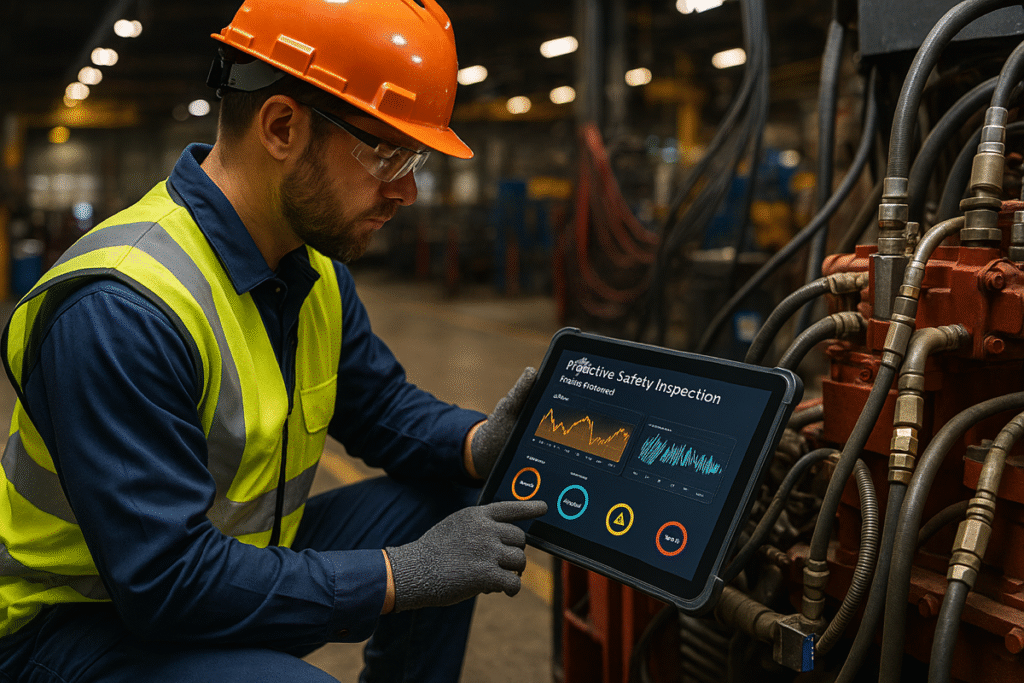
Unplanned equipment downtime is no longer just a maintenance problem; it is a safety, reliability, and business continuity issue. When a crane, truck, compressor, or production line fails unexpectedly, the risk of workers improvising, rushing repairs, or bypassing safeguards increases dramatically. Traditional time-based inspections often miss early warning signs because they are scheduled on the calendar, not driven by how equipment is actually being used. Predictive safety inspections grounded in data, condition monitoring, and leading indicators offer a way to improve uptime while strengthening occupational safety and regulatory compliance.
OSHA’s recommended practices for safety and health programs emphasize systematic hazard identification, preventive maintenance, and ongoing evaluation of controls as core elements of a strong program, not optional add-ons (Occupational Safety and Health Administration (OSHA), n.d.-a). When inspections become predictive rather than purely reactive, organizations can detect mechanical, electrical, and process deviations before they escalate into breakdowns or serious incidents. This directly supports both safety performance and uptime: fewer surprise failures, fewer emergency shutdowns, and fewer situations where workers are exposed during rushed repairs.
Predictive safety inspections build on the same foundation as predictive maintenance but explicitly integrate safety-critical conditions into the inspection logic. Instead of only tracking vibration or temperature trends to avoid a failed bearing, the organization also flags conditions that could compromise guarding, lockout/tagout, load-handling integrity, emergency stopping, or environmental releases. The U.S. Department of Energy’s Federal Energy Management Program highlights how disciplined operations and maintenance practices reduce downtime, improve reliability, and lower life-cycle costs, especially when condition-based strategies are used. Extending that logic into safety inspections ensures that the same data streams protecting uptime also protect people.
Emerging technologies are making this much more feasible. NIOSH’s Future of Work initiative describes how advanced sensors, digital monitoring, and data analytics are changing the way organizations manage hazards and design work systems (National Institute for Occupational Safety and Health (NIOSH), n.d.-a). In practical terms, this can include telematics on mobile equipment, temperature and pressure sensors on critical components, run-hour tracking, real-time load monitoring for cranes, and digital pre-use inspection checklists that automatically flag patterns. When that data is analyzed for trends rising fault codes, repeated inspection comments, increasing near misses safety teams can intervene before a failure occurs.
One of the biggest benefits of predictive inspections is the ability to prioritize risk. Not all equipment has the same consequence of failure. A minor conveyor fault might create a small delay; a hoisting system fault, on the other hand, could result in dropped loads or structural damage. OSHA’s guidance on controlling hazardous energy underscores that maintenance and servicing activities must be carefully planned to prevent unexpected startup and release of stored energy (OSHA, n.d.-b). Predictive safety inspections can help identify when lockout/tagout will soon be necessary because components are trending toward unsafe conditions allowing maintenance to be scheduled under controlled, low-risk conditions instead of in the middle of an emergency.
Predictive inspections also support a more integrated view of worker health and safety. NIOSH’s Total Worker Health approach stresses that worker well-being is influenced by both traditional safety hazards and the way work is organized, including workload, scheduling, and system reliability (NIOSH, n.d.-b). Chronic equipment problems often force workers into overtime, uncomfortable improvisation, and repetitive “band-aid” fixes. By stabilizing equipment reliability using predictive data, organizations reduce those stressors. Workers spend less time reacting to crises and more time operating within defined procedures, which improves both morale and safety culture.
To make predictive safety inspections effective, organizations need three things: quality data, clear criteria, and disciplined follow-through. Quality data comes from sensors, telematics, digital inspections, and incident reports that are consistently captured and stored in usable formats. Clear criteria define what thresholds or patterns will trigger an inspection, a temporary derate, or a planned outage. Disciplined follow-through ensures that when inspections reveal early signs of failure abnormal temperatures, repeated leaks, unusual noise, deformation, unusual error codes maintenance and safety teams act quickly rather than deferring action until “the next shutdown.” This alignment between maintenance, operations, and safety is where uptime and injury prevention reinforce each other rather than compete.
For construction, fleet, manufacturing, logistics, and rail-support environments, predictive safety inspections can be phased in without overwhelming the organization. Many companies start with a small group of high-risk assets: cranes, elevated work platforms, critical lifting devices, mainline production machines, or specialized rail equipment. They then build a common inspection template that includes both reliability conditions (vibration, fluid leaks, warning lights) and safety-critical elements (guarding, emergency stops, load indicators, restraints, environmental controls). Over time, patterns from that initial set of assets are used to refine triggers, improve training, and design better checklists.
If your organization is still relying on purely calendar-based inspections or paper checklists that never feed into analytics, there is a strong opportunity to improve both uptime and safety by moving toward a predictive model. Starting small with a defined asset set, clear rules, and digital tools is often enough to demonstrate value and build leadership support.
For organizations that want structured help designing this transition, Key Safety LLC can support the development of predictive safety inspection frameworks, digital checklists, and cross-functional workflows that align with OSHA, NIOSH, and DOE expectations. This includes identifying high-consequence assets, embedding safety criteria into maintenance programs, standardizing inspection content across sites, and training supervisors and technicians to interpret leading indicators before they become failures.
By treating predictive safety inspections as a core part of your safety and reliability strategy, you can reduce unscheduled downtime, protect workers from avoidable exposure, and build a more resilient operation that is ready for regulatory scrutiny and future growth.
References
National Institute for Occupational Safety and Health. (n.d.-a). Future of work. Centers for Disease Control and Prevention. https://www.cdc.gov/niosh/future-of-work/about/?CDC_AAref_Val=https://www.cdc.gov/niosh/topics/future-of-work/default.html
National Institute for Occupational Safety and Health. (n.d.-b). Total Worker Health. Centers for Disease Control and Prevention. https://www.cdc.gov/niosh/twh/?CDC_AAref_Val=https://www.cdc.gov/niosh/twh/default.html
Occupational Safety and Health Administration. (n.d.-a). Recommended practices for safety and health programs. U.S. Department of Labor. https://www.osha.gov/safety-management
Occupational Safety and Health Administration. (n.d.-b). Control of hazardous energy (lockout/tagout). U.S. Department of Labor. https://www.osha.gov/control-hazardous-energy
Comments:
