

Predictive Risk Modeling in Modern Safety Programs for Construction, Manufacturing, and Railroad Operations
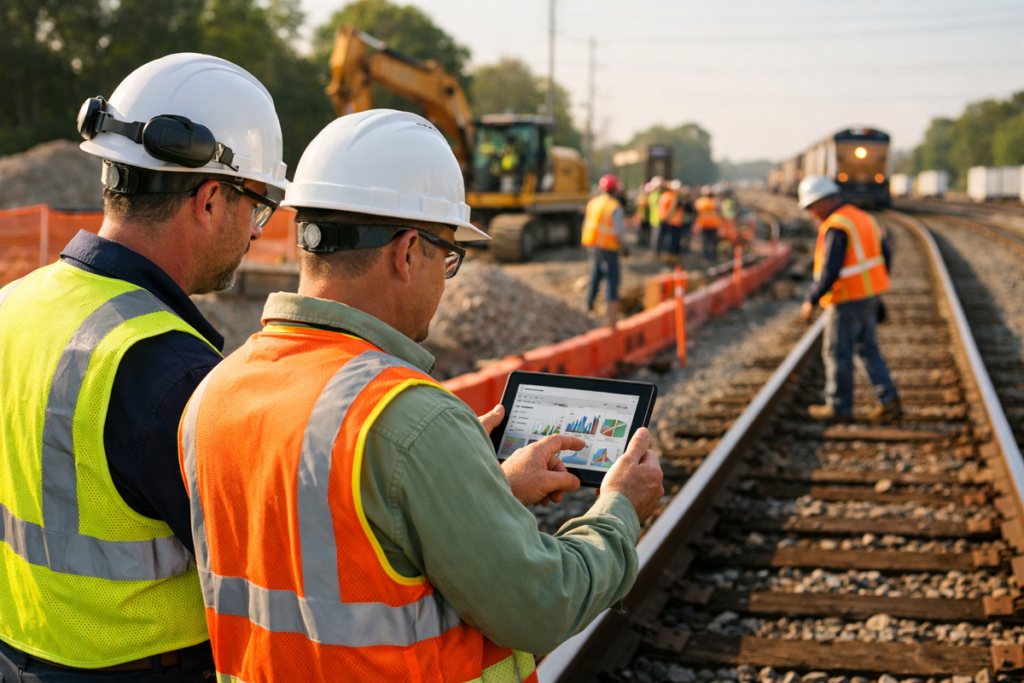
EHS consulting leaders are increasingly using predictive risk modeling to strengthen OSHA compliance, safety management, and risk management in complex operating environments. In construction, manufacturing, and railroad operations, predictive methods help organizations anticipate where serious hazards are most likely to emerge, so controls can be deployed before performance drifts into an incident.
Predictive risk modeling is not a replacement for strong fundamentals; it is an accelerator of them. When it is built on consistent field execution, reliable data capture, and disciplined corrective action, predictive modeling becomes a practical way to prioritize inspections, target supervision, improve contractor oversight, and validate whether risk controls are actually working as intended within a modern safety program (e.g., management leadership, worker participation, hazard identification, and continuous improvement) (Occupational Safety and Health Administration (OSHA), n.d.-a).
Problem analysis
Most organizations still rely heavily on lagging indicators such as recordable injuries and severity. Those measures matter, but they confirm harm after the fact. OSHA has emphasized that effective programs “find and fix hazards before they cause injury or illness,” and that trend analysis across incidents and near misses is a core part of hazard identification and assessment (OSHA, n.d.-a); (OSHA, n.d.-b). Predictive risk modeling operationalizes that expectation by using leading indicators conditions, behaviors, and system signals that tend to precede failures to forecast elevated exposure before someone gets hurt.
NIOSH similarly describes leading indicators as proactive and predictive measures that help identify and eliminate risks before incidents occur, which is the conceptual bridge between traditional program management and predictive analytics (National Institute for Occupational Safety and Health [NIOSH], 2016). In high-hazard work, this matters because the “risk surface” changes daily: crews rotate, work phases shift, weather changes, equipment ages, production pressure rises, and contractors interact in new ways.
Sector reality reinforces why prediction is valuable. Employer-reported injury and illness rates vary by industry, and executives need an evidence-based method to decide where risk controls yield the greatest return (in human and operational terms). BLS industry incidence rate tables provide a credible benchmark for understanding recordable case rates and DART trends at a national level, which can be paired with internal data to detect abnormal patterns earlier (U.S. Bureau of Labor Statistics [BLS], 2024).
Leadership and operational implications
Predictive risk modeling succeeds or fails based on leadership governance, not software selection. If executives treat predictive outputs as “interesting analytics” instead of operational priorities, the program becomes noise. If leaders treat predictive outputs as a basis for targeted prevention assigning owners, deadlines, verification, and learning loops then predictive modeling becomes an extension of core OSHA-aligned program elements such as hazard identification, prevention and control, training, and program evaluation (OSHA, n.d.-c).
Construction leaders tend to see the fastest value when predictive modeling is anchored to phase-based hazards and contractor interfaces. For example, elevated risk clusters often appear at transitions: steel erection to decking, excavation to utilities, commissioning to turnover. Predictive models can weight risk upward when multiple contributors converge, such as schedule compression, high worker density, lift-plan complexity, weather exposure, and repeated near-miss themes. The operational implication is simple: supervision and controls should surge where risk is forecasted, not only where incidents already happened.
Manufacturing leaders often gain value by connecting risk signals from maintenance and quality to safety exposure. Predictive modeling can flag risk when machine guarding work orders surge, when PM intervals are missed, when jam-clearing frequency rises, or when overtime patterns correlate with increased line interventions. This is a governance opportunity: predictive risk should be a standing agenda item that integrates operations, maintenance, quality, and EHS, rather than an EHS-only report.
Railroad leaders face an additional expectation: robust, consistent reporting and classification. FRA accident/incident reporting requirements exist to provide accurate information about hazards and risks on the nation’s railroads, supporting enforcement and risk reduction (Federal Railroad Administration [FRA], 2025); (49 C.F.R. pt. 225, 2026). Predictive risk modeling in rail environments is strengthened when reporting discipline is strong and when the organization treats close calls, inspection findings, and rule compliance observations as “leading evidence,” not administrative burden.
Strategic approach and best practices
Predictive risk modeling should be implemented as a controlled improvement to the safety management system, with defined inputs, decision rules, and verification of outcomes. ISO 45001 reinforces the concept of systematically assessing hazards and implementing risk controls within an OH&S management system framework, which aligns naturally with predictive approaches when they are used to improve prevention and control not simply to score sites (International Organization for Standardization [ISO], n.d.).
A practical approach starts with data that is already available and credible. OSHA recordkeeping and electronic reporting infrastructure is an example of how organizations can standardize injury and illness data management, while internal systems can capture near misses, inspections, JSAs, PTWs, maintenance indicators, and supervision activity (OSHA, n.d.-d); (OSHA, n.d.-e). The predictive objective is not to collect “more data,” but to collect better signals that correlate with exposure. In construction and rail settings, field verification is particularly important: if the model says risk is rising, leaders should be able to walk the work and see why.
From there, predictive modeling should be tied to control selection and effectiveness verification. OSHA’s hierarchy of controls remains the correct anchor: prediction should drive decisions toward elimination, substitution, engineering controls, and robust administrative controls before relying on PPE as the primary barrier (OSHA, 2023). To keep predictive modeling from becoming punitive, organizations should focus on system learning and control integrity. OSHA’s discussion of leading indicators supports this orientation by emphasizing preventive measures that drive change before incidents occur (OSHA, 2019).
For organizations that want this to stick operationally, Key Safety LLC typically advises building a governance rhythm that includes consistent field inputs, clear trigger thresholds, defined actions when thresholds are met, and post-action validation to confirm that risk actually reduced. The goal is executive clarity: what the model predicts, what actions follow, who owns them, and what evidence closes the loop.
Conclusion
Predictive risk modeling is most valuable when it strengthens core safety management expectations: disciplined hazard identification, timely prevention and control, and continuous improvement. In construction, manufacturing, and railroad operations, it enables leaders to concentrate oversight and controls where the organization is most exposed, rather than spreading effort evenly or waiting for lagging indicators to confirm failure. When implemented with OSHA-aligned program fundamentals and management system rigor, predictive modeling becomes a practical lever to reduce serious risk and improve operational reliability (OSHA, n.d.-a); (ISO, n.d.).
Book a Meeting here
References
Federal Railroad Administration. (2025, March 27). Accident data, reporting, and investigations. U.S. Department of Transportation. https://railroads.dot.gov/railroad-safety/accident-data-reporting-and-investigations-0
International Organization for Standardization. (n.d.). ISO 45001:2018—Occupational health and safety management systems—Requirements with guidance for use. https://www.iso.org/standard/63787.html
National Institute for Occupational Safety and Health. (2016, February 17). How to put leading indicators into practice. Centers for Disease Control and Prevention. https://www.cdc.gov/niosh/blogs/2016/lead.html
Occupational Safety and Health Administration. (n.d.-a). Recommended practices for safety and health programs. U.S. Department of Labor. https://www.osha.gov/safety-management
Occupational Safety and Health Administration. (n.d.-b). Safety management—Hazard identification and assessment. U.S. Department of Labor. https://www.osha.gov/safety-management/hazard-identification
Occupational Safety and Health Administration. (n.d.-c). Safety management—Hazard prevention and control. U.S. Department of Labor. https://www.osha.gov/safety-management/hazard-prevention
Occupational Safety and Health Administration. (n.d.-d). Injury tracking application (ITA). U.S. Department of Labor. https://www.osha.gov/injuryreporting
Occupational Safety and Health Administration. (n.d.-e). Establishment-specific injury and illness data. U.S. Department of Labor. https://www.osha.gov/Establishment-Specific-Injury-and-Illness-Data
Occupational Safety and Health Administration. (2019). Using leading indicators to improve safety and health outcomes(Publication No. OSHA 4029). U.S. Department of Labor. https://www.osha.gov/sites/default/files/publications/OSHA_Leading_Indicators.pdf
Occupational Safety and Health Administration. (2023). Identifying hazard control options: The hierarchy of controls(Publication No. OSHA 3071). U.S. Department of Labor. https://www.osha.gov/sites/default/files/Hierarchy_of_Controls_02.01.23_form_508_2.pdf
U.S. Bureau of Labor Statistics. (2024, November 8). TABLE 1. Incidence rates of nonfatal occupational injuries and illnesses by industry and case types, 2023. https://www.bls.gov/web/osh/table-1-industry-rates-national.htm
Railroad Accidents/Incidents: Reports Classification, and Investigations, 49 C.F.R. pt. 225 (2026). https://www.ecfr.gov/current/title-49/subtitle-B/chapter-II/part-225
Comments:
