

Delays Caused by Poor Route Risk Analysis: The Hidden Cost in Rail, Trucking, and Logistics
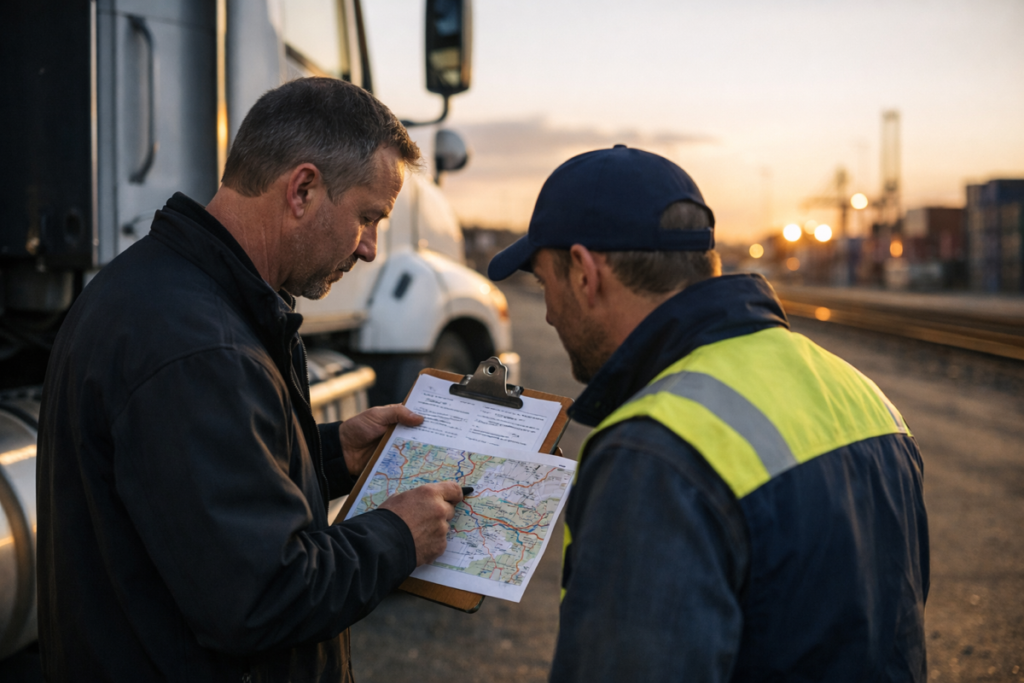
EHS consulting and OSHA compliance often focus on incident prevention, but in transportation, railroad, and logistics operations, poor route risk analysis is also a direct driver of schedule failure, cost escalation, and customer dissatisfaction. When route hazards are not systematically identified and managed, delays show up as “unavoidable” weather events, congestion surprises, last-minute re-routes, missed delivery windows, Hours-of-Service constraints, yard dwell, and exposure to higher-risk corridors that should have been mitigated earlier.
Leaders typically see route planning as an operational function, yet regulators increasingly expect structured, risk-based processes that prevent predictable failures. For motor carriers, Hours of Service limits constrain how much “delay” a plan can absorb before it becomes noncompliant or unsafe. For rail, safety programs and risk-based hazard management expectations reinforce that risk is not accidental; it is managed through deliberate analysis and controls. For employers, the duty to provide a workplace free from recognized hazards is not limited to a fixed facility; it extends to work arrangements that predictably expose workers to serious harm. (29 U.S.C. § 654, 2018).
Problem analysis
Route risk analysis fails most often in three ways. First, organizations treat routing as “shortest path” optimization rather than a risk-and-constraint decision. Congestion patterns, construction restrictions, grade crossings, steep grades, terminal access limits, local curfews, and hazmat restrictions can convert a nominally efficient route into a fragile plan that collapses with minor disruption. Second, planning is commonly disconnected from legal fatigue and duty-cycle constraints. Under the federal Hours of Service framework, delays are not merely inconvenient; they compress available driving windows and can trigger cascading service failures or unsafe decision-making. (Hours of service of drivers, 2025). Third, many organizations do not define what “route risk” means in measurable terms, so dispatch, drivers, and field supervisors have no shared basis for escalation, alternates, or stop-work authority.
In hazmat movements, poor routing discipline becomes higher-stakes. Federal routing rules and carrier responsibilities exist precisely because route choices can shift exposure and consequence across communities and infrastructure. (Transportation of hazardous materials; driving and parking rules, 2025). In rail, modern safety frameworks similarly emphasize structured risk-based hazard management as part of system safety programming. (System safety program, 2025).
The operational reality is that poor route risk analysis produces delays long before an incident occurs. These delays have leading indicators: repeated detention at particular customer sites, recurring missed appointments in the same metro area, frequent adverse-weather re-routing without preplanned alternates, and chronic driver “clock burn” near terminals. If leadership only tracks lagging outcomes like crashes or claims, route risk stays invisible until service and safety degrade together.
Leadership and operational implications
Transportation and warehousing remain a high-fatality sector, and roadway incidents are a persistent driver of serious outcomes, which places executive attention on exposure management rather than reactive response. (U.S. Bureau of Labor Statistics [BLS], 2024). A weak routing risk process also creates compliance exposure. When dispatch plans assume impossible travel times, the system pressures drivers toward rushed behaviors, incomplete inspections, and fatigue risk. The National Transportation Safety Board has repeatedly emphasized fatigue risk and the need for structured fatigue management approaches across transportation modes. (National Transportation Safety Board [NTSB], 2017).
For rail and intermodal operations, poor route risk analysis also impacts network fluidity and yard performance. Unplanned detours, temporary slow orders, terminal congestion, and interchange delays have safety dimensions, including worker exposure during extended switching, increased roadway interface events near terminals, and higher human-factor risk under schedule recovery pressure. Regulators’ movement toward risk-based programs in rail underscores that safety performance is expected to improve through proactive hazard identification and mitigation, not post-event correction. (System safety program, 2025).
Strategic approach and best practices
A credible route risk program treats routing as a controlled process within a safety management system, aligned to OSHA compliance, DOT requirements, and internal service expectations. Practically, this means leadership defines route risk criteria and decision rights, then ensures operational teams have usable tools and escalation pathways.
A strong approach starts with segmentation. Not every movement requires the same rigor. High-consequence freight, hazmat, oversize loads, high-value shipments, mountainous terrain, severe-weather corridors, and congested metro deliveries demand deeper preplanning. Hazard identification should incorporate known restrictions, historical delay points, exposure factors, and consequence modeling concepts that align with how transportation regulators think about risk elements such as exposure and consequences. (Pipeline and Hazardous Materials Safety Administration [PHMSA], 2024).
Next, integrate routing with duty-cycle reality. Dispatch plans should be validated against Hours of Service and fatigue risk triggers, not after the fact. This is where leading organizations connect planned transit time, buffer allowances, staging locations, and appointment windows to compliance constraints. (Hours of service of drivers, 2025). A disciplined plan also defines preapproved alternates and stop points, so drivers and crews are not forced into improvisation under pressure.
Then, close the loop with performance intelligence. Use a small set of route risk KPIs that connect service to safety: repeat delay nodes, frequency of unplanned re-routes, HOS-driven service failures, near-miss reports tied to specific corridors, and terminal dwell patterns that correlate with incident precursors. FMCSA’s safety performance concepts and compliance tools reflect the reality that operational management controls shape on-road outcomes, and carriers can adapt these concepts internally to strengthen risk controls. (FMCSA, 2025).
Finally, align governance and training. Route risk analysis fails when it is “owned by nobody.” Leadership should assign accountability, define when planners must escalate, and ensure that contractors and third parties follow the same routing controls. Key Safety LLC typically supports this step by designing practical route-risk standards, conducting targeted audits against DOT and internal requirements, and building operator-ready procedures that fit real dispatch and rail terminal workflows.
Conclusion
Delays caused by poor route risk analysis are rarely random. They are a predictable outcome of planning that ignores constraints, underestimates exposure, and fails to define decision rights. A risk-based routing program reduces delays and strengthens compliance by making route choice a managed control, not an afterthought. The result is improved service reliability, lower fatigue pressure, more consistent hazmat routing discipline, and fewer “surprise” disruptions that drive cost and risk at the same time.
Book a Meeting here
References
Safety Measurement System (SMS) methodology: Behavior analysis and safety improvement category (BASIC) prioritization status (Version 3.20). U.S. Department of Transportation. https://csa.fmcsa.dot.gov/documents/smsmethodology.pdf.
Standard for Hours of service of drivers, 49 C.F.R. § 395 (2025). https://www.ecfr.gov/current/title-49/subtitle-B/chapter-III/subchapter-B/part-395
Standard for Transportation of hazardous materials; driving and parking rules, 49 C.F.R. § 397 (2025). https://www.ecfr.gov/current/title-49/subtitle-B/chapter-III/subchapter-B/part-397
Standard for System safety program, 49 C.F.R. § 270 (2025). https://www.ecfr.gov/current/title-49/subtitle-B/chapter-II/part-270
National Transportation Safety Board. (2017). Reduce fatigue-related accidents: 2017–2018 Most Wanted List [Fact sheet]. https://www.ntsb.gov/Advocacy/mwl/Documents/2017-18/2017MWL-FctSht-Fatigue-H.pdf
Pipeline and Hazardous Materials Safety Administration. (2024, March 19). Risk and regulatory analysis overview. U.S. Department of Transportation. https://www.phmsa.dot.gov/hazmat-program-management-data-and-statistics/risk-and-regulatory-analysis/risk-and-regulatory
Bureau of Labor Statistics. (2024, December 19). National census of fatal occupational injuries in 2023 [News release]. U.S. Department of Labor. https://www.bls.gov/news.release/cfoi.nr0.htm
Standard for Duties of employers and employees, 29 U.S.C. § 654 (2018). https://uscode.house.gov/view.xhtml?path=/prelim@title29/chapter15&edition=prelim
Comments:
