

Tackling outdated hazard assessments in legacy systems.
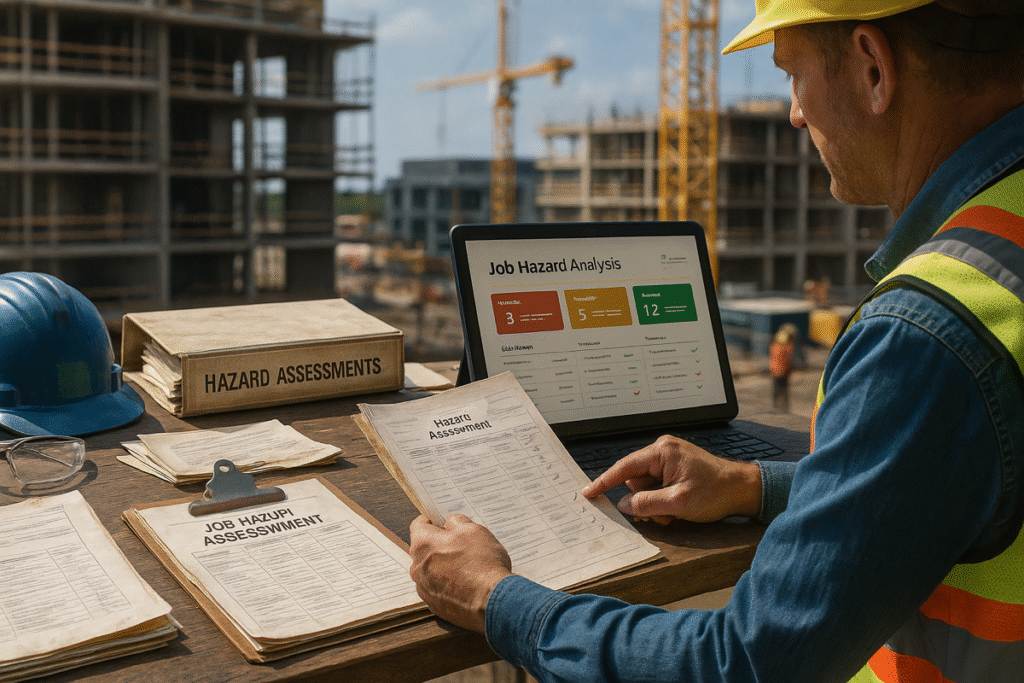
Tackling outdated hazard assessments in legacy systems is no longer just a “good practice” it is a core requirement for any organization that wants to stay compliant, prevent serious incidents, and maintain operational credibility. Many companies still rely on paper-based job hazard analyses, static spreadsheets, or assessments created years ago for processes that have changed significantly. When new equipment, materials, technologies, or work patterns are introduced but hazard assessments remain unchanged, risk is effectively managed against a past version of reality, not the current one. OSHA’s recommended practices for safety and health programs emphasize that hazard identification and assessment must be proactive and ongoing, not a one-time exercise completed and filed away (Occupational Safety and Health Administration, 2024a).
Legacy hazard assessment systems typically fail in three ways. First, they do not capture emerging risks created by new construction methods, automation, contracting models, and climate-related stressors. Second, they make it difficult to compare risks across multiple sites because each location may use a different template or evaluation method. Third, they slow down updates, since revising a paper JHA or a static PDF requires manual edits, printing, and redistribution. NIOSH underscores that effective hazard assessment considers the full relationship between the worker, the work, the environment, and the tools being used, and that assessments must be revisited as tasks and exposures evolve (National Institute for Occupational Safety and Health, 2022a).
Current federal guidance clearly supports modernization. OSHA describes a job hazard analysis as a technique for identifying hazards before they cause injuries, focusing on the relationship between the worker, the task, the tools, and the work environment (OSHA, 2023). The U.S. Department of Labor recently outlined six steps for an effective job hazard analysis, including prioritizing jobs, analyzing each step, identifying hazards, describing those hazards, selecting controls, and periodically reviewing the analysis to ensure it remains current (U.S. Department of Labor, 2024). None of this can be done reliably if assessments are buried in legacy systems that are rarely opened or too cumbersome to update.
Modernizing hazard assessments using digital tools offers several advantages. Digital JHA platforms allow organizations to standardize formats, embed the hierarchy of controls, and ensure that every assessment explicitly considers elimination, substitution, engineering controls, administrative controls, and personal protective equipment. NIOSH’s hierarchy of controls framework emphasizes that organizations should systematically apply the most effective controls first to protect workers from injuries, illnesses, and fatalities (NIOSH, 2022b). When assessments are built and maintained in a digital environment, leaders can quickly filter by task, trade, site, or risk level, identify outdated documents, and trigger reviews after incidents, near misses, or operational changes.
Digitized hazard assessments also strengthen program evaluation and continuous improvement. OSHA’s safety and health program guidelines highlight that employers should routinely evaluate their programs, track progress toward goals, and refine controls based on performance data and worker feedback (OSHA, 2024b). When hazard assessments are connected to incident data, audit findings, and leading indicators, patterns become visible that would remain hidden in disconnected legacy files. This allows organizations to prioritize high-risk tasks, align controls across sites, and demonstrate to regulators, clients, and workers that risk management is active, not symbolic.
For organizations that recognize these gaps but are unsure where to start, partnering with an expert can accelerate progress. Key Safety LLC supports leaders in construction, transportation, manufacturing, and related sectors by reviewing existing hazard assessment systems, mapping them against OSHA and NIOSH expectations, and designing digital, standardized JHA frameworks that can be maintained over time. This includes aligning templates with the hierarchy of controls, integrating field feedback, and building practical workflows for updates following process changes, incidents, or new regulatory requirements.
By moving away from outdated, legacy hazard assessments and toward dynamic, digitally enabled systems, organizations build a more resilient safety culture. They not only reduce the likelihood of serious incidents but also improve their ability to adapt, prove compliance, and protect workers in a rapidly changing risk environment.
If you want support in updating your hazard assessments, standardizing JHAs across sites, or integrating digital inspections into your safety program, visit Key Safety LLC at https://www.key-safety.com and subscribe to our newsletter for ongoing guidance and resources.
References
National Institute for Occupational Safety and Health. (2022a, April 28). Hazard assessment/determination. Centers for Disease Control and Prevention. https://www.cdc.gov/niosh/learning/safetyculturehc/module-2/11.html
National Institute for Occupational Safety and Health. (2022b, April 28). Hierarchy of controls. Centers for Disease Control and Prevention. https://www.cdc.gov/niosh/learning/safetyculturehc/module-3/2.html
Occupational Safety and Health Administration. (2023). Job hazard analysis worksheet. U.S. Department of Labor. https://www.osha.gov/sites/default/files/Job_Hazard_Analysis_Worksheet.pdf
Occupational Safety and Health Administration. (2024a). Recommended practices for safety and health programs. U.S. Department of Labor. https://www.osha.gov/safety-management
Occupational Safety and Health Administration. (2024b). Program evaluation and improvement. U.S. Department of Labor. https://www.osha.gov/safety-management/program-evaluation
U.S. Department of Labor. (2024, July 9). 6 steps to an effective job hazard analysis. https://blog.dol.gov/2024/07/09/6-steps-to-an-effective-job-hazard-analysis
Comments:
