

How Safety Incidents Impact Investor Confidence in Construction and Manufacturing
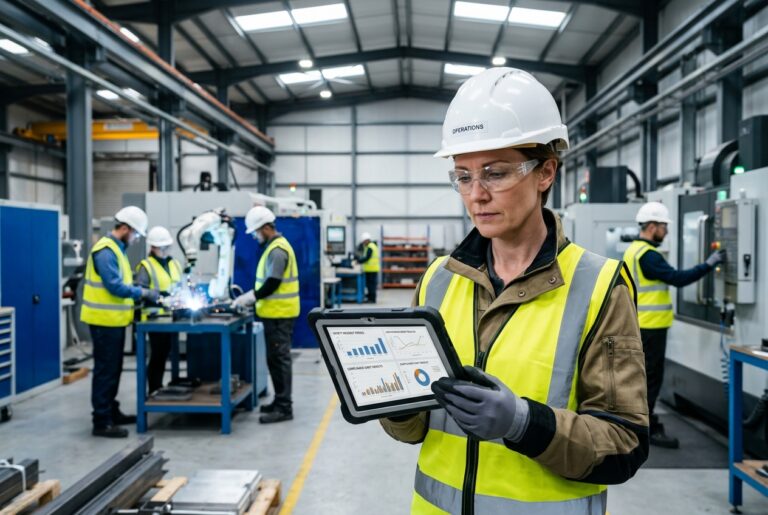
A single safety incident can do more damage to a construction or manufacturing company’s standing with investors, lenders, and business partners than months of otherwise solid financial performance. That is not an exaggeration of the regulatory environment; it is a direct consequence of how much workplace safety data is now public, standardized, and actively used by capital providers to price risk. The Bureau of Labor Statistics recorded 1,034 fatal work injuries in the construction industry in 2024, a rate of 9.2 deaths per 100,000 full-time equivalent workers, while manufacturing recorded 355 fatalities the same year (U.S. Bureau of Labor Statistics, 2026). Every one of those incidents generates a public record, an OSHA case file, and, increasingly, a data point that shows up in investor and lender due diligence long before it appears in a company’s own disclosures.
This article examines how safety incidents translate into investor confidence risk for construction and manufacturing companies specifically, the federal mechanisms driving that scrutiny, and how organizations can build the kind of safety program that protects both their workforce and their standing with the capital markets and business partners they depend on. It also outlines how Key Safety LLC supports clients in building that foundation.
Why Investors Now Treat Safety as a Financial Signal
For decades, workplace safety was treated internally as an operational and legal compliance matter, largely separate from how a company presented itself to investors. That separation has narrowed substantially. In August 2020, the Securities and Exchange Commission amended Regulation S-K to require public companies to disclose their human capital resources to the extent material to understanding the business, a principles-based requirement that took effect on November 9, 2020 (U.S. Securities and Exchange Commission, 2020). Workplace health and safety measures fall squarely within the scope of human capital disclosure, meaning safety performance is no longer just an OSHA matter. It is now, for public companies and the private companies that supply and partner with them, part of the information set investors are expected to evaluate.
The practical effect for construction and manufacturing is significant, because these are among the industries where human capital and safety disclosure carries the most material weight. A company whose safety data lags its industry peers is not just facing potential OSHA penalties. It is presenting a data point that a sophisticated investor, lender, or institutional partner can read as a governance and operational risk signal, whether or not that risk has yet materialized into a specific incident.
The Federal Data That Shapes Investor Perception
OSHA’s Severe Violator Enforcement Program
OSHA’s Severe Violator Enforcement Program (SVEP) concentrates enforcement resources on employers that have demonstrated indifference to their obligations under the OSH Act through willful, repeated, or failure-to-abate violations (Occupational Safety and Health Administration, n.d.-a). The program maintains a public case log listing the names, locations, citations, and penalty amounts of enrolled employers, the majority of whom come from the construction industry, and an employer remains listed for a minimum of three years after completing abatement. For a small or midsize construction or manufacturing firm, landing on this public list is not a private regulatory matter. It is a searchable record that can affect lines of credit, bonding capacity, referrals, and the willingness of larger contractors or institutional partners to extend new business, precisely the relationships that determine whether a company can access the capital and project pipeline it needs to grow.
The Direct and Indirect Cost of Incidents
OSHA’s own guidance on the business case for safety and health makes the financial exposure explicit: employers pay nearly $1 billion per week in direct workers’ compensation costs alone, and that figure does not include the indirect costs of training replacement workers, investigating incidents, implementing corrective measures, repairing damaged equipment, and absorbing the lost productivity and lower morale that follow a serious incident (Occupational Safety and Health Administration, n.d.-b). For investors and lenders evaluating a construction or manufacturing company, these are not abstract figures. They translate directly into margin volatility, insurance cost trajectory, and the kind of unpredictable liability exposure that erodes confidence in management’s ability to control operational risk.
Uneven Disclosure Creates Its Own Risk
Because SEC human capital disclosure is principles-based rather than prescriptive, companies have wide latitude in how they report safety performance, and that latitude has produced inconsistent practice across the market. A large share of companies provide only qualitative statements about their commitment to safety, while a much smaller share disclose the kind of quantitative incident rate or safety investment data that allows genuine comparison across peers. For a construction or manufacturing company, this inconsistency cuts both ways. A company with strong, well-documented safety performance that discloses only qualitative language is leaving a differentiation opportunity on the table, while a company with weaker performance that also discloses only qualitative language may be read by a sophisticated investor as having something to hide.
Industry Impact: Construction and Manufacturing
Construction
Construction recorded the second-highest number of workplace fatalities of any private industry in 2024, with falls, harmful substance exposure, and transportation incidents as the leading causes. Construction firms are also disproportionately represented on OSHA’s severe violator list, which compounds the investor confidence problem: a sector already carrying elevated baseline risk in the eyes of capital providers faces an even steeper credibility gap when a specific company’s safety record lags its peers. For construction firms pursuing project financing, surety bonding, or partnerships with developers and general contractors who are themselves under investor and lender pressure, a documented safety record is increasingly a precondition for being considered at all, not just a competitive advantage.
Manufacturing
Manufacturing fatalities declined roughly 10% in 2024 to 355, with contact incidents, including workers caught or compressed by running equipment, remaining the leading cause of death in the sector. Manufacturing companies often carry additional investor scrutiny because safety incidents in this sector frequently correlate with equipment failures, maintenance lapses, or process deficiencies that also signal broader operational risk, the kind of finding that shows up not just in an OSHA citation but in a lender’s or investor’s assessment of overall management competence and capital efficiency.
Regulatory and Governance Implications
Construction and manufacturing companies now operate under a layered set of expectations: OSHA recordkeeping and enforcement exposure, principles-based SEC human capital disclosure for public companies and their major suppliers, and an informal but very real diligence process in which lenders, sureties, and institutional partners pull public OSHA and BLS data directly. Treating safety as purely an internal compliance function, disconnected from how the company is perceived by capital providers, leaves a governance gap that becomes visible the moment an incident occurs or a diligence team runs a basic search.
Business Implications Beyond the Incident Itself
The business cost of a safety incident extends well past the immediate OSHA penalty. Companies with weak safety records face higher insurance premiums, tighter bonding terms, more difficulty securing favorable loan covenants, and, for those pursuing capital from institutional investors, a documented risk factor that competitors with stronger safety records do not carry. Conversely, companies that can point to consistent, well-documented safety performance, backed by accurate OSHA recordkeeping and a credible safety management system, are better positioned to negotiate financing terms, win bids from safety-conscious general contractors and developers, and present a cleaner risk profile to any investor or partner conducting due diligence.
Risk Reduction Strategies
Protecting investor confidence starts with the same fundamentals that protect the workforce, applied through Key Safety LLC’s Four Safety Pillars.
Safety & Health Training. Consistent, documented training reduces the incident frequency that drives both OSHA exposure and the operational risk signals investors and lenders watch for.
Hazard Prevention & Control. Systematic hazard identification and control, particularly around the fall, contact, and equipment hazards that dominate construction and manufacturing fatality data, produces the auditable safety record that differentiates a company in due diligence.
Worksite Analysis. Regular worksite analysis catches the conditions most likely to produce a reportable incident or an OSHA citation before they materialize into the kind of event that damages investor and partner confidence.
Management Commitment & Employee Involvement. Visible leadership commitment and genuine worker participation in safety programs are what separate a paper compliance program from a real safety culture, and that distinction is increasingly what investors, lenders, and institutional partners are trying to assess when they look past the qualitative safety language in a disclosure.
How Key Safety LLC Supports Construction and Manufacturing Clients
Key Safety LLC helps construction and manufacturing companies build the safety infrastructure that protects investor and lender confidence rather than exposing them to unnecessary risk. Through Document Development for Start-Up Projects, Key Safety LLC helps new and growing companies establish OSHA-compliant recordkeeping systems and documented safety management programs from the outset, structured to hold up under both regulatory audit and financial due diligence.
For organizations with existing programs, Key Safety LLC’s Service on Demand model provides targeted support for tasks such as auditing recordkeeping accuracy ahead of a financing round or bonding renewal, preparing safety data for an investor or lender questionnaire, or responding to an active OSHA inspection before it escalates toward severe violator status. Regular Consultation Services extend this support on an ongoing basis, giving safety directors and executives a consistent partner as expectations around safety disclosure continue to evolve.
Construction and manufacturing companies pursuing federal, state, or local government contracts should also know that Key Safety LLC is registered and active in the System for Award Management (SAM.gov), the official U.S. government database used to vet and identify qualified vendors for federal awards (General Services Administration, n.d.). Active SAM.gov registration is a prerequisite for any entity seeking to bid on federal contracts or receive federal funding, giving contracting officers, and by extension any partner evaluating the company, a verified record of its standing. This registration reflects the same standard of regulatory diligence Key Safety LLC brings to every client’s safety and risk management engagement.
Building a Safety Record That Protects Confidence, Not Just Compliance
Safety incidents no longer stay contained within an OSHA file. For construction and manufacturing companies, they surface in severe violator lists, in the cost data that shapes insurance and bonding terms, and increasingly in the human capital disclosures that investors read as a proxy for management quality. Companies that build documented, consistently applied safety programs now are the ones that protect not only their workforce, but their standing with every lender, investor, and partner who will eventually look at their safety record before deciding whether to do business with them.
Key Safety LLC helps construction and manufacturing organizations build safety programs that protect investor confidence while genuinely protecting their workforce. To assess where your organization stands, contact Key Safety LLC at key-safety.com/contact-us.
Subscribe to the Key Safety LLC newsletter for ongoing EHS and compliance updates: Subscribe here.
References
General Services Administration. (n.d.). System for Award Management (SAM.gov). https://sam.gov
Occupational Safety and Health Administration. (n.d.-a). Severe Violator Enforcement Program (SVEP). U.S. Department of Labor. https://www.osha.gov/enforcement/svep
Occupational Safety and Health Administration. (n.d.-b). Business case for safety and health — Costs. U.S. Department of Labor. https://www.osha.gov/businesscase/costs
U.S. Bureau of Labor Statistics. (2026, February 19). Census of fatal occupational injuries summary, 2024. U.S. Department of Labor. https://www.bls.gov/news.release/cfoi.nr0.htm
U.S. Securities and Exchange Commission. (2020, August 26). Modernization of Regulation S-K Items 101, 103, and 105 (Release No. 33-10825). https://www.sec.gov/files/rules/final/2020/33-10825.pdf
