

Year-End Safety Review: How to Align 2026 Safety Performance with 2027 Goals in Manufacturing, Railroad, and Construction
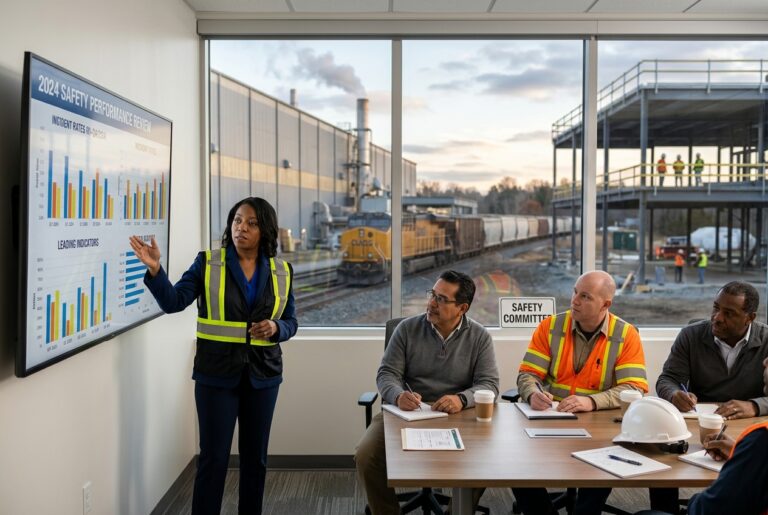
As the calendar year closes, most organizations finalize budgets, forecast revenue, and set operational targets for the year ahead. A year-end safety review belongs in that same planning cycle. It is the structured process of measuring how the safety program performed during the past twelve months, understanding why results moved in the direction they did, and translating those lessons into specific, resourced goals for 2027. For manufacturing plants, railroads, and construction contractors, this review is more than an internal exercise. It feeds regulatory recordkeeping deadlines in the first quarter, supports insurance renewals, and determines whether next year’s safety plan protects people and operations or simply repeats this year’s results.
Many companies still close the year by counting injuries and moving on. That approach misses the most valuable information. The Occupational Safety and Health Administration encourages employers to pair lagging indicators, which measure events that already occurred, with leading indicators, which are proactive, preventive, and predictive measures of how well safety activities are working (Occupational Safety and Health Administration [OSHA], 2019). A strong year-end safety review uses both, and this article explains how to conduct one, which regulatory obligations it supports in each industry, and how to convert the findings into 2027 goals that drive measurable improvement.
Why the Year-End Safety Review Matters for 2027 Planning
OSHA’s Recommended Practices for Safety and Health Programs identify program evaluation and improvement as a core element of an effective safety program, alongside management leadership, worker participation, hazard identification and assessment, hazard prevention and control, education and training, and communication and coordination among host employers, contractors, and staffing agencies (OSHA, 2016). The year-end safety review is the natural moment to apply that element across the entire program. It answers three questions every leadership team should be able to answer before approving next year’s budget: what happened, why it happened, and what the organization will do differently.
Leading indicators make that analysis useful. OSHA explains that leading indicators allow employers to address a weakness or hazard before it causes an incident, while lagging indicators primarily reveal problems after harm has occurred, and the agency recommends using both together: leading indicators to drive change and lagging indicators to confirm whether the change worked (OSHA, 2019). When a year-end safety review shows that inspection completion dropped in the third quarter and recordable injuries rose in the fourth, leaders gain a clear, actionable story instead of a single annual number.
External benchmarks add perspective. The U.S. Bureau of Labor Statistics scheduled the release of its 2025 Survey of Occupational Injuries and Illnesses for November 18, 2026 (Bureau of Labor Statistics [BLS], n.d.). The most recent published data showed 2.5 million nonfatal workplace injuries and illnesses in private industry in 2024 (BLS, 2026). Comparing your own incidence rates against current industry data helps leaders set 2027 targets that are ambitious but realistic.
Industry Impact: Manufacturing, Railroad, and Construction
Manufacturing
In manufacturing, the year-end safety review begins with the OSHA 300 Log. Employers must review the log at the end of each calendar year, verify that entries are complete and accurate, correct any deficiencies, and prepare the annual summary (Annual Summary, 2025). That review is also the right time to analyze where injuries originated by department, shift, task, and equipment. OSHA’s preliminary list of the most frequently cited standards for fiscal year 2026 includes hazard communication, lockout/tagout, respiratory protection, powered industrial trucks, and machine guarding (OSHA, n.d.-b). A year-end safety review that audits each of those programs against actual plant conditions gives manufacturers a precise starting point for 2027 improvement goals.
Railroad Operations
Railroads already operate under a federally defined review cycle. Under the Risk Reduction Program rule, a railroad with an approved plan must conduct an internal assessment once every calendar year to determine the extent to which it has achieved its implementation milestones, complied with its approved plan, achieved the goals described in the plan, and implemented previous improvement plans (Annual Internal Assessments, 2025). The railroad must then submit an internal assessment report, signed by its chief official responsible for safety, within 60 days of completing the assessment (Internal Assessment Reports, 2025). In other words, federal rules already require railroads to perform a year-end safety review against their own goals.
Other rail deadlines cluster around the turn of the year. Each railroad with 400,000 or more total employee hours must submit its drug and alcohol testing management information system report for the previous calendar year by March 15 (Annual Report, 2025). Under the training standards in 49 CFR Part 243, employers with 400,000 or more total employee work hours annually must write yearly reviews of their training’s effectiveness and adjust initial and refresher training as needed (Federal Railroad Administration [FRA], n.d.). The May 2026 amendments to Part 243 also delayed the refresher training deadline for small entities to December 31, 2026 (Training, Qualification, and Oversight for Safety-Related Railroad Employees, 2026). For short line railroads and rail contractors, that date makes the year-end safety review an urgent compliance checkpoint.
Construction
Construction contractors face a unique challenge at year-end because projects start, finish, and transition throughout the year. Construction fall protection under 29 CFR 1926.501 ranks first on OSHA’s preliminary fiscal year 2026 list of most frequently cited standards, with scaffolding, ladders, fall protection training, and eye and face protection also in the top 10 (OSHA, n.d.-b). A construction year-end safety review should compare performance across projects, evaluate subcontractor safety performance, review the effectiveness of site-specific safety plans, and identify which crews and trades need targeted training before the 2027 building season accelerates.
Regulatory Implications: First-Quarter 2027 Deadlines Your Review Should Support
A year-end safety review produces the verified data that several regulatory deadlines require. After reviewing the 2026 OSHA 300 Log and preparing the Form 300A summary, a company executive must certify that summary, and employers must post it in each establishment from February 1 through April 30, 2027 (Annual Summary, 2025). The certification requirement places personal accountability on senior leadership, which is a strong reason for executives to participate directly in the review.
Electronic submission follows. Establishments with 20 to 249 employees in designated industries, and establishments with 250 or more employees that keep OSHA records, must submit Form 300A data electronically, and establishments with 100 or more employees in designated higher-hazard industries must also submit Forms 300 and 301 (Electronic Submission of Employer Injury and Illness Records to OSHA, 2025). Submissions are due by March 2 of the year after the calendar year covered (Electronic Submission of Employer Injury and Illness Records to OSHA, 2025), and OSHA’s Injury Tracking Application provides a coverage tool to confirm which establishments must report (OSHA, n.d.-a). For railroads, the March 15 drug and alcohol MIS report and the annual Risk Reduction Program internal assessment add to the same first-quarter workload. A disciplined year-end safety review completed in November and December prevents a rushed scramble in February and March.
Business Implications: Connecting Safety Goals to Budgets, Insurance, and Profit
The year-end safety review belongs in the business planning cycle because safety goals require resources. Engineering controls, training hours, equipment upgrades, and supervisory time all compete for budget dollars. When the review quantifies where risk concentrates and which controls will reduce it, leaders can fund the 2027 safety plan with the same confidence they bring to capital projects.
The review also strengthens the conversations that follow it. Insurers and brokers evaluate loss history and program evidence at renewal, a connection we examined in our article on how safety maturity lowers workers’ compensation costs. Customers, railroads, and project owners evaluate safety performance during prequalification and contractor approval. And every incident prevented in 2027 protects margin, as we explained in our discussion of safety and profitability as a profit protection system. A well-documented year-end safety review gives leadership a single, defensible picture of performance to share with each of these stakeholders.
Risk Reduction Strategies: A Five-Step Year-End Safety Review Process
The first step is to validate the data. Reconcile the OSHA 300 Log with incident reports, first aid logs, and workers’ compensation claims, and confirm that every recordable case is classified correctly. For railroads, reconcile accident and incident reporting, testing records, and training records. Accurate data is the foundation of every decision that follows, and it is a regulatory requirement in its own right.
The second step is worksite analysis. Analyze lagging indicators by location, department, task, and contractor, then examine the leading indicators behind them: inspection completion, hazard reports, near-miss reporting, corrective action closure times, and training currency. Look for patterns that repeat across quarters, and conduct root cause reviews of the most significant events rather than relying on summary counts.
The third step is to set 2027 goals that combine leading and lagging measures. A strong goal states a specific target, a deadline, an owner, and the resources required. Examples include achieving full completion of monthly lockout/tagout audits in every production area, closing all high-risk corrective actions within fourteen days, or completing Part 243 refresher training for every safety-related employee before the deadline. Lagging targets, such as reductions in recordable and lost-time cases, then confirm whether the leading activities are working.
The fourth step is to secure management commitment and employee involvement. Present the review findings to senior leadership alongside the budget request, assign each goal to a named leader, and share the results with employees and safety committees. Workers who helped identify the hazards are the most effective partners in controlling them, and their participation reflects the worker involvement that both OSHA’s Recommended Practices and FRA’s Risk Reduction Program emphasize.
The fifth step is to build the hazard prevention and training plan. Translate each goal into specific controls, prioritizing engineering solutions under the hierarchy of controls, and schedule the safety and health training needed to support them. Then set a quarterly review cadence so the 2027 plan stays on track. Organizations pursuing or maintaining an occupational health and safety management system can align this cadence with the management review expectations of ISO 45001 (International Organization for Standardization, 2018), which turns the year-end safety review into one milestone in a continuous improvement cycle.
How Key Safety LLC Supports Your Year-End Safety Review
Key Safety LLC helps manufacturing, railroad, and construction organizations turn year-end data into a practical, funded safety plan for the year ahead. Through Regular Consultation Services, we facilitate your year-end safety review, analyze leading and lagging indicators, and help leadership set 2027 goals with clear ownership. Through Service on Demand, we support targeted needs such as OSHA 300 Log audits, Form 300A preparation, Part 243 training program reviews, and incident trend analysis. Through Document Development for Start-Up Projects, we prepare the written programs, site-specific safety plans, and training materials your new 2027 projects will require before work begins.
Our approach combines regulatory precision with practical field experience across construction, manufacturing, and railroad operations, and we build every plan around the four pillars of effective safety management: management commitment and employee involvement, worksite analysis, hazard prevention and control, and safety and health training. We serve clients in Florida and nationwide through virtual consulting. Review our EHS consulting services for OSHA, DOT, and FRA compliance, compare our consulting packages and pricing, find answers in our frequently asked questions about EHS consulting, or explore more insights on the Key Safety LLC safety blog.
Start Your Year-End Safety Review Today
The weeks between now and the end of December are the most valuable planning window of the year. A structured year-end safety review gives your leadership team accurate data for first-quarter regulatory deadlines, a clear explanation of 2026 results, and a focused set of 2027 goals that protect your workforce and your operations. Contact Key Safety LLC today to schedule your year-end safety review and start 2027 with a plan built for results.
References
Annual Internal Assessments, 49 C.F.R. § 271.401 (2025). https://www.law.cornell.edu/cfr/text/49/271.401
Annual Report, 49 C.F.R. § 219.800 (2025). https://www.law.cornell.edu/cfr/text/49/219.800
Annual Summary, 29 C.F.R. § 1904.32 (2025). https://www.osha.gov/laws-regs/regulations/standardnumber/1904/1904.32
Bureau of Labor Statistics. (n.d.). Injuries, illnesses, and fatalities. U.S. Department of Labor. Retrieved November 14, 2026, from https://www.bls.gov/iif
Bureau of Labor Statistics. (2026, January 22). Employer-reported workplace injuries and illnesses — 2024 (News Release No. USDL-26-0101). U.S. Department of Labor. https://www.bls.gov/news.release/osh.nr0.htm
Electronic Submission of Employer Injury and Illness Records to OSHA, 29 C.F.R. § 1904.41 (2025). https://www.osha.gov/laws-regs/regulations/standardnumber/1904/1904.41
Federal Railroad Administration. (n.d.). Training standards rule. U.S. Department of Transportation. Retrieved November 14, 2026, from https://railroads.dot.gov/divisions/safety-partnerships/training-standards-rule
Internal Assessment Reports, 49 C.F.R. § 271.405 (2025). https://www.law.cornell.edu/cfr/text/49/271.405
International Organization for Standardization. (2018). Occupational health and safety management systems — Requirements with guidance for use (ISO Standard No. 45001:2018). https://www.iso.org/standard/63787.html
Occupational Safety and Health Administration. (n.d.-a). Injury Tracking Application (ITA) information. U.S. Department of Labor. Retrieved November 14, 2026, from https://www.osha.gov/injuryreporting
Occupational Safety and Health Administration. (n.d.-b). Top 10 most frequently cited standards. U.S. Department of Labor. Retrieved November 14, 2026, from https://www.osha.gov/top10citedstandards
Occupational Safety and Health Administration. (2016). Recommended practices for safety and health programs (OSHA Publication No. 3885). U.S. Department of Labor. https://www.osha.gov/sites/default/files/OSHA3885.pdf
Occupational Safety and Health Administration. (2019). Using leading indicators to improve safety and health outcomes(OSHA Publication No. 3970). U.S. Department of Labor. https://www.osha.gov/sites/default/files/OSHA_Leading_Indicators.pdf
Training, Qualification, and Oversight for Safety-Related Railroad Employees, 91 Fed. Reg. 27849 (May 15, 2026) (codified at 49 C.F.R. pt. 243). https://www.govinfo.gov/content/pkg/FR-2026-05-15/html/2026-09790.htm
