

Safety Audit Failures: Lessons Learned for Railroad, Manufacturing, and Construction Leaders
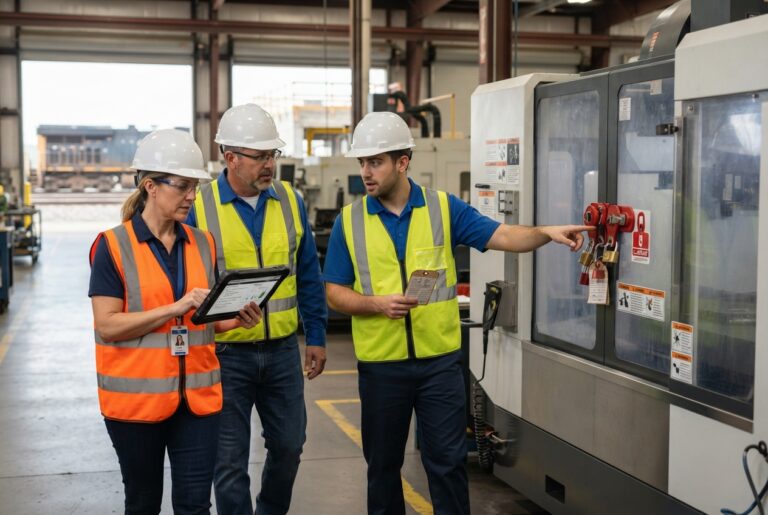
Few moments are as uncomfortable for a leadership team as reading the findings of a failed safety audit. Whether the audit came from a regulator, a customer, a railroad, a certification body, or an internal team, the message is the same: the safety program the organization believed it had is not the program operating in the field. Yet safety audit failures also offer one of the most valuable learning opportunities a company will ever receive. They expose the gaps between policy and practice while there is still time to close them, before those gaps produce an injury, a repeat citation, or a lost contract.
The Occupational Safety and Health Administration recommends that employers evaluate their safety and health programs initially to verify that they are being implemented as intended, and then review what is and is not working at least once a year (Occupational Safety and Health Administration [OSHA], n.d.-b). Organizations that follow that discipline rarely experience serious audit surprises. This article examines what safety audit failures reveal, shares documented lessons from railroad, manufacturing, and construction settings, explains the regulatory and business consequences of unresolved findings, and outlines practical steps to turn every audit finding into lasting improvement.
What Safety Audit Failures Really Reveal
Most safety audit failures do not happen because a company has no safety program. They happen because the written program and the working program have drifted apart. Procedures exist but are not followed, committees are chartered but do not meet, training is scheduled but not documented, and corrective actions are opened but never verified. An audit simply makes that drift visible.
OSHA’s guidance on program evaluation and improvement describes three actions that prevent this drift. Employers should monitor performance and progress by defining indicators and reviewing both lagging indicators, such as past injuries and exposures, and leading indicators, such as prevention activities. They should verify, initially and at least annually, that the program is operating as intended. And when they find a gap, they should take prompt action to correct the problem and prevent its recurrence (OSHA, n.d.-b). When an organization experiences safety audit failures, at least one of those three actions has usually broken down.
The scale of the challenge remains significant. Private industry employers reported 2.5 million nonfatal workplace injuries and illnesses in 2024 (Bureau of Labor Statistics, 2026). Behind many of those cases sits a program element that looked complete on paper but failed in practice, which is exactly the kind of weakness a well-designed audit is meant to catch.
Industry Impact: Lessons from Railroad, Manufacturing, and Construction
Railroad: Lessons from a Federal Risk Reduction Program Audit
The railroad industry offers an unusually transparent example of how safety audit failures develop. In May 2024, the Federal Railroad Administration published the results of its external audit of Norfolk Southern Railway’s Risk Reduction Program, covering the period from the plan’s approval in March 2022 through September 2023 (Federal Railroad Administration, 2024). FRA identified eight defects and did not recommend civil penalties. Its findings stated that the railroad had completed a risk-based hazard analysis for some, but not all, of the required factors, that it was not using the Risk Committee described in its plan, that it lacked an effective safety outreach process, and that it did not ensure adequate employee involvement in the processes outlined in its plan (Federal Railroad Administration, 2024).
The report also noted that employees and managers in the field showed limited knowledge of the program, that the railroad did not achieve all of the milestones in its implementation timeline, and that FRA attributed the gaps mainly to inadequate staffing and insufficient resources (Federal Railroad Administration, 2024). The railroad responded by describing corrective actions already underway, including a reorganized safety department, an expanded field safety team, recalibrated risk committees, and employee training. The lesson for every rail employer and rail contractor is direct: an approved plan is not an implemented plan, and a program without dedicated people and resources will eventually show up in safety audit failures.
Federal rules also define what happens next. When an FRA external audit identifies deficiencies, the railroad must submit an improvement plan within 60 days of receiving written notice of the results, and that plan must describe the improvements, identify the position titles of the individuals responsible, and set implementation milestones that are specific and measurable (External Audit Improvement Plans, 2025). That structure is a useful model for responding to safety audit failures in any industry.
Manufacturing
In manufacturing, safety audit failures tend to cluster around the same programs that appear on OSHA’s preliminary list of the most frequently cited standards for fiscal year 2026: hazard communication, lockout/tagout, respiratory protection, powered industrial trucks, and machine guarding (OSHA, n.d.-c). The pattern behind those findings is familiar. A plant has a written energy control program, but the periodic inspections of energy control procedures required at least annually under 29 CFR 1910.147(c)(6) are missing or undocumented. A hazard communication program exists, but labels, safety data sheets, and training records no longer match the chemicals on the floor. Forklift operators are trained once, but performance evaluations under 29 CFR 1910.178 lapse. Each gap is small on its own, and together they produce the safety audit failures that manufacturers see most often.
Construction
Construction audit findings often begin with fall protection. Construction fall protection under 29 CFR 1926.501 ranks first on OSHA’s preliminary fiscal year 2026 list, and fall protection training under 29 CFR 1926.503 also appears in the top 10, along with scaffolding, ladders, and eye and face protection (OSHA, n.d.-c). Many construction safety audit failures trace back to documentation rather than equipment: missing written training certifications, site-specific safety plans that were never updated after the scope changed, and subcontractor safety programs that were collected during prequalification but never verified in the field. For general contractors, those gaps extend responsibility beyond their own crews to every trade on the site.
Regulatory Implications: Why Unresolved Findings Become Repeat Violations
The most expensive consequence of an unresolved audit finding is often a repeat citation. Under OSHA’s Field Operations Manual, an employer can be cited for a repeated violation when it has previously been cited for the same or a substantially similar condition or hazard and that earlier citation has become a final order (OSHA, n.d.-a). The policy generally applies when the new citation is issued within five years of the final order date or the final abatement date of the previous citation, whichever is later, and the repeat history can include the employer’s establishments nationwide, not only the site under inspection (OSHA, n.d.-a).
That nationwide scope turns a local audit finding into an enterprise-wide risk. If a lockout/tagout deficiency is corrected at one plant but ignored at a sister facility, or a fall protection gap is fixed on one project but repeated on the next, the company’s exposure grows with each location. For 2026, OSHA penalties for willful or repeated violations reach up to $165,514 per violation (OSHA, 2026). In rail, the same principle applies through FRA’s follow-up on improvement plans and implementation milestones. Safety audit failures that are documented but not resolved become the evidence regulators use in the next review.
Business Implications: The Hidden Cost of Audit Failures
Beyond penalties, safety audit failures affect revenue and reputation. Customers, railroads, and project owners increasingly audit their contractors and suppliers, and a failed audit can delay approval, suspend work, or remove a company from future bid lists. Certification audits under management system standards such as ISO 45001 (International Organization for Standardization, 2018) can result in major nonconformities that put certification, and the contracts that depend on it, at risk.
Safety audit failures also consume management time. Leaders who must rebuild programs under pressure spend weeks on corrective work that a routine internal review would have prevented. As we explained in our discussion of safety and profitability as a profit protection system, every dollar lost to preventable failures must be recovered through new revenue. The organizations that treat audits as learning tools, rather than tests to pass, avoid most of that cost.
Lessons Learned: Turning Safety Audit Failures into Lasting Improvement
The first lesson is to verify practice, not paper. Effective audits include field observations and conversations with workers and supervisors, as FRA’s audit did when it interviewed officials and employees and reviewed committee records. Ask employees to explain the procedure they use, observe the task, and compare both with the written program. That approach supports the worksite analysis pillar of an effective safety program and reveals drift long before it turns into safety audit failures during an external review.
The second lesson is to resource the program. When a regulator attributes findings mainly to inadequate staffing and insufficient resources, the message applies far beyond one railroad. Management commitment means assigning qualified people, protected time, and budget to the program, and reviewing whether those resources still match the size and complexity of the operation.
The third lesson is to involve employees from the start. Several of the documented rail findings involved committees that did not meet consistently, inconsistent craft representation, and limited field knowledge of the program. Employee involvement is not a communication exercise. It means giving workers a defined role in identifying hazards, evaluating controls, and verifying corrective actions, and documenting that participation.
The fourth lesson is to close findings with root cause analysis and measurable milestones. A finding closed with a quick fix will return, which is why so many safety audit failures repeat. Follow the model in FRA’s improvement plan requirements: describe the improvement, assign a responsible position, and set specific, measurable milestones (External Audit Improvement Plans, 2025). Then verify effectiveness after implementation, as OSHA recommends when it calls for action that prevents recurrence (OSHA, n.d.-b).
The fifth lesson is to share findings across every site and project. Because OSHA’s repeat violation policy can consider an employer’s establishments nationwide, a finding at one location should trigger a review at all similar locations. Construction contractors should carry lessons from one project into the next site-specific safety plan, and manufacturers should standardize corrections across plants.
The sixth lesson is to treat training records as audit evidence. Hazard prevention and control depends on competent workers, and auditors judge competence through documentation, and missing records are among the most common safety audit failures. Maintain current training certifications, competency evaluations, and refresher schedules, and confirm that records match the people actually performing the work.
The seventh lesson is to audit continuously. Use leading indicators such as inspection completion, corrective action closure times, and near-miss reporting to monitor program health every month, and schedule internal audits throughout the year rather than only before an external review. A year-end evaluation, like the process we described in our guide to the year-end safety review and 2027 goals, then becomes a confirmation of progress rather than a discovery of problems.
How Key Safety LLC Helps You Prevent and Recover from Safety Audit Failures
Key Safety LLC helps railroad, manufacturing, and construction organizations prepare for audits, respond to findings, and build programs that hold up under any review. Through Service on Demand, we conduct independent gap assessments and mock audits, analyze audit findings, investigate root causes, and develop corrective action and improvement plans with measurable milestones. Through Regular Consultation Services, we provide ongoing oversight that keeps programs current, monitors leading indicators, and verifies that corrections remain effective across every site. Through Document Development for Start-Up Projects, we prepare the written programs, site-specific safety plans, and training documentation that new projects need to pass their first review.
Our approach combines regulatory precision with practical field experience across construction, manufacturing, and railroad operations, and we build every program around the four pillars of effective safety management: management commitment and employee involvement, worksite analysis, hazard prevention and control, and safety and health training. We serve clients in Florida and nationwide through virtual consulting. Review our EHS consulting services for OSHA, DOT, and FRA compliance, compare our consulting packages and pricing, find answers in our frequently asked questions about EHS consulting, or explore more insights on the Key Safety LLC safety blog.
Turn Your Next Audit into a Strength
Every audit tells a story about how well your safety program works in the field. The organizations that learn from safety audit failures, resource their programs, involve their workers, and close findings for good turn that story into a competitive advantage. Contact Key Safety LLC today to schedule an independent gap assessment and make your next audit a confirmation of strength rather than a list of findings.
Contact Key Safety LLC: https://key-safety.com/contact-us/
References
Bureau of Labor Statistics. (2026, January 22). Employer-reported workplace injuries and illnesses — 2024 (News Release No. USDL-26-0101). U.S. Department of Labor. https://www.bls.gov/news.release/osh.nr0.htm
External Audit Improvement Plans, 49 C.F.R. § 271.503 (2025). https://www.law.cornell.edu/cfr/text/49/271.503
Federal Railroad Administration. (2024). FRA audit report: Norfolk Southern Railway Risk Reduction Program (Audit No. 2024-NS271-10-1). U.S. Department of Transportation. https://railroads.dot.gov/sites/fra.dot.gov/files/2024-05/FRA%20NS%20RRP%20Audit%20Final%20Report%2005.17.24.pdf
International Organization for Standardization. (2018). Occupational health and safety management systems — Requirements with guidance for use (ISO Standard No. 45001:2018). https://www.iso.org/standard/63787.html
Occupational Safety and Health Administration. (n.d.-a). Field operations manual: Chapter 4. Violations. U.S. Department of Labor. Retrieved November 18, 2026, from https://www.osha.gov/fom/chapter-4
Occupational Safety and Health Administration. (n.d.-b). Program evaluation and improvement. U.S. Department of Labor. Retrieved November 18, 2026, from https://www.osha.gov/safety-management/program-evaluation
Occupational Safety and Health Administration. (n.d.-c). Top 10 most frequently cited standards. U.S. Department of Labor. Retrieved November 18, 2026, from https://www.osha.gov/top10citedstandards
Occupational Safety and Health Administration. (2026, May 21). 2026 OSHA civil penalties update: No inflation adjustment and updated minimum penalties [Memorandum]. U.S. Department of Labor. https://www.osha.gov/memos/2026-05-21/2026-annual-adjustments-osha-civil-penalties
