

AI in Safety: What Is Real and What Is Marketing Hype in Construction, Manufacturing, and Railroad Operations
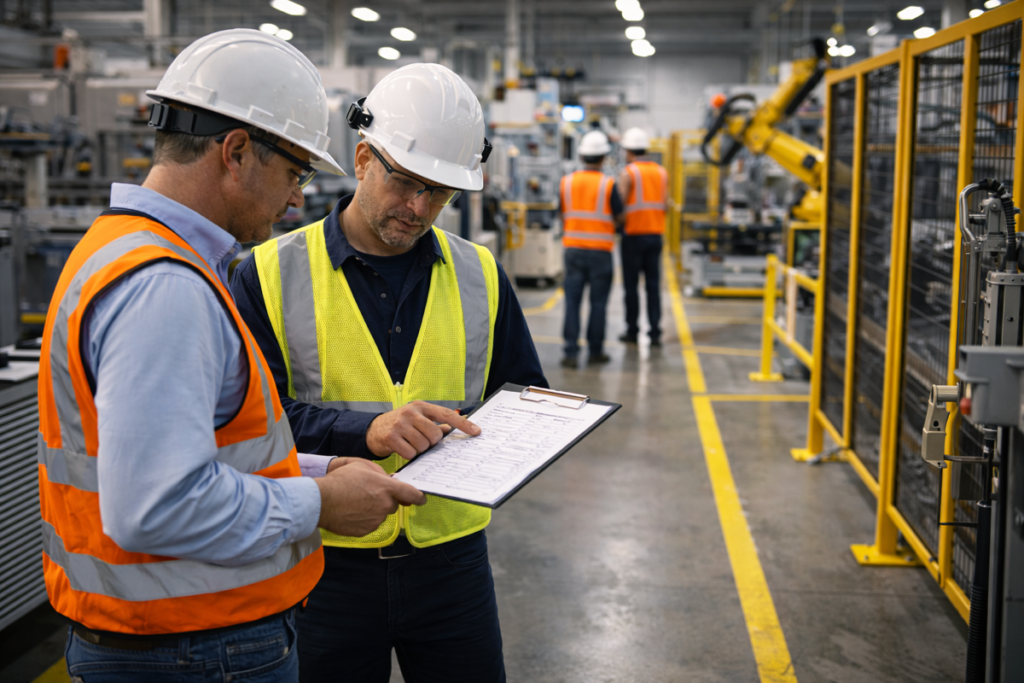
Artificial intelligence is now a dominant theme in EHS consulting, OSHA compliance discussions, and safety management marketing. In construction, manufacturing, and railroad operations, vendors increasingly promise that AI will “predict incidents,” “eliminate human error,” or “automate safety oversight.” For executive leaders, separating what AI can realistically deliver from what is marketing hype has become essential to sound risk management.
Regulators have not endorsed AI as a substitute for management leadership, hazard identification, or prevention and control. OSHA continues to emphasize that effective safety programs depend on leadership accountability, worker participation, and systematic hazard management not technology alone (Occupational Safety and Health Administration [OSHA], n.d.-a). Understanding where AI supports these fundamentals and where it does not is critical.
Problem analysis
Much of the confusion around AI in safety stems from vague definitions. AI is often marketed as a singular solution, when in reality it encompasses a range of tools including machine learning, computer vision, and pattern recognition applied to structured data. When disconnected from strong safety fundamentals, these tools frequently generate noise rather than insight.
OSHA has made clear that injury rates and automated metrics alone do not reflect program effectiveness. Organizations must identify hazards, evaluate risks, and verify that controls are working (OSHA, n.d.-b). AI systems trained on incomplete, biased, or fragmented data cannot replace this responsibility. In many cases, AI outputs simply mirror the quality of the underlying data and the discipline of the organization using it.
NIOSH reinforces that leading indicators must be deliberately selected, validated, and acted upon. Predictive tools do not eliminate the need for professional judgment or field verification (Inouye, 2016). When AI is positioned as a shortcut around leadership engagement or hazard control, it becomes marketing hype rather than risk management.
Leadership and operational implications
In manufacturing environments, AI can provide real value when applied to clearly defined problems. Machine-learning models can analyze equipment condition, maintenance histories, and process deviations to highlight where risk exposure may be increasing. When used appropriately, these insights support OSHA’s expectation for ongoing evaluation of hazard prevention effectiveness (OSHA, n.d.-c).
However, executives should be cautious of claims that AI can independently “ensure compliance” or “guarantee safety.” OSHA compliance remains the employer’s responsibility, and no technology shifts that accountability. AI systems do not conduct meaningful job hazard analyses, ensure worker training quality, or verify that engineering controls are functioning as designed. Leaders remain accountable for those outcomes.
Construction and railroad operations face similar realities. Computer vision systems may detect PPE usage or proximity risks, but they do not understand work sequencing, human factors, or changing site conditions unless governed by disciplined processes. FRA accident and incident data exists to support risk understanding, but AI tools cannot replace the obligation to analyze events, identify systemic causes, and implement corrective actions (Federal Railroad Administration [FRA], 2025); (49 C.F.R. pt. 225, 2026).
Strategic approach and best practices
The most effective use of AI in safety aligns with existing management system frameworks rather than attempting to bypass them. ISO 45001 emphasizes leadership responsibility, risk-based thinking, and performance evaluation areas where AI can assist by improving visibility and prioritization, not decision authority (International Organization for Standardization [ISO], n.d.).
OSHA supports the use of leading indicators to improve safety outcomes, but it does not prescribe automation as a substitute for prevention (OSHA, 2019). Realistic AI applications include trend detection across inspections, maintenance backlog analysis, ergonomic exposure pattern recognition, and prioritization of corrective actions. Hype-driven applications promise autonomous safety management without addressing governance, accountability, or data integrity.
Key Safety LLC typically advises leaders to evaluate AI tools through a risk management lens: What specific hazard or decision does this tool improve? How does it integrate with existing safety processes? Who validates outputs, and how are actions verified in the field? When these questions cannot be answered clearly, the technology is likely adding complexity rather than control.
Conclusion
AI in safety is neither a cure-all nor a passing trend. In construction, manufacturing, and railroad operations, its real value lies in supporting not replacing strong safety management fundamentals. OSHA and ISO frameworks consistently reinforce that leadership accountability, hazard identification, and control verification remain non-negotiable (OSHA, n.d.-a; ISO, n.d.). Executives who approach AI with discipline, clarity, and governance will extract value; those who chase marketing hype risk obscuring the very risks they are responsible for managing.
Book a Meeting here
References
Federal Railroad Administration. (n.d.). Accident data, reporting, and investigations. U.S. Department of Transportation. https://railroads.dot.gov/railroad-safety/accident-data-reporting-and-investigations-0
International Organization for Standardization. (2018). Occupational health and safety management systems — Requirements with guidance for use (ISO Standard No. 45001:2018). https://www.iso.org/standard/63787.html
Inouye, J. (2016, February 17). How to put leading indicators into practice. NIOSH Science Blog. National Institute for Occupational Safety and Health. https://www.cdc.gov/niosh/blogs/2016/lead.html
Occupational Safety and Health Administration. (n.d.-a). Recommended practices for safety and health programs. U.S. Department of Labor. https://www.osha.gov/safety-management
Occupational Safety and Health Administration. (n.d.-b). Safety management—Hazard identification and assessment. U.S. Department of Labor. https://www.osha.gov/safety-management/hazard-identification
Occupational Safety and Health Administration. (n.d.-c). Safety management—Hazard prevention and control. U.S. Department of Labor. https://www.osha.gov/safety-management/hazard-prevention
Occupational Safety and Health Administration. (2019). Using leading indicators to improve safety and health outcomes (OSHA Publication No. 3970). U.S. Department of Labor. https://www.osha.gov/sites/default/files/publications/OSHA_Leading_Indicators.pdf
Railroad Accidents/Incidents: Reports Classification, and Investigations, 49 C.F.R. pt. 225 (2026). https://www.ecfr.gov/current/title-49/subtitle-B/chapter-II/part-225
Comments:
