

What to Do Before, During, and After an Earthquake
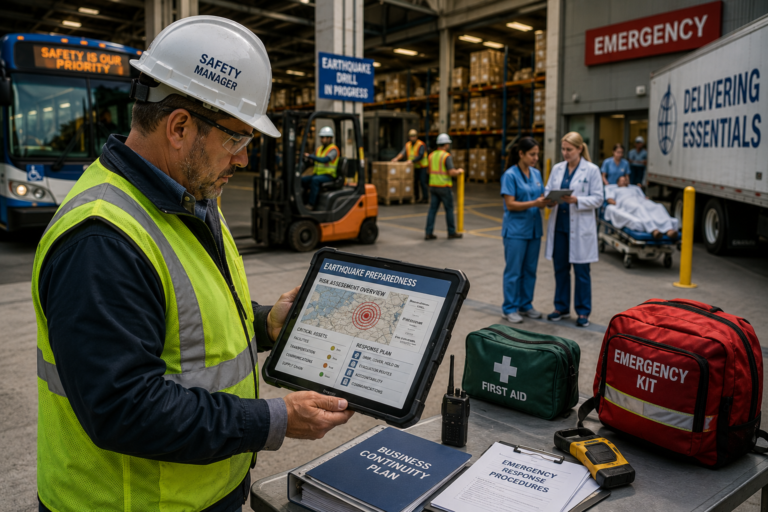
EHS consulting and workplace safety programs are placing growing emphasis on natural hazard readiness as a core part of comprehensive risk management. Although earthquakes are commonly linked to particular geographic regions, their impact on transportation networks, healthcare systems, and logistics operations can be sudden, severe, and highly disruptive. Organizations that know what actions to take before, during, and after an earthquake are far better positioned to protect employees, sustain critical operations, and speed up recovery efforts.
Earthquakes pose distinct challenges because they strike with little or no warning. Unlike hurricanes or severe storms that usually allow time to prepare, seismic events require organizations to focus on emergency preparedness long before an incident occurs. For transportation facilities, healthcare organizations, and logistics operations, preparedness can strongly shape employee safety, infrastructure resilience, and business continuity.
The Occupational Safety and Health Administration (OSHA) stresses emergency preparedness and emergency action planning as critical components of workplace safety programs (Occupational Safety and Health Administration [OSHA], n.d.). Effective earthquake preparedness starts with understanding site-specific risks and putting measures in place that reduce vulnerability before an event occurs.
Before an earthquake occurs, organizations should perform facility assessments to identify potential hazards such as unsecured equipment, shelving systems, storage racks, suspended fixtures, utility systems, and critical infrastructure. For healthcare safety, facilities should evaluate patient-care continuity, backup power capabilities, and protection of medical equipment. As part of logistics risk management, transportation and logistics organizations should assess operational dependencies, communications systems, and supply chain vulnerabilities.
Training is just as important. Employees should know emergency procedures, evacuation routes, shelter-in-place protocols, and communication expectations. Organizations should run regular drills that help workers respond quickly and confidently when seismic activity occurs.
During an earthquake, the actions employees take can greatly reduce injuries. OSHA and emergency management agencies recommend the “Drop, Cover, and Hold On” approach. People should immediately drop to their hands and knees, take cover beneath sturdy furniture or near interior walls, and hold on until the shaking stops. Workers should stay clear of windows, glass surfaces, heavy equipment, and unsecured objects that could become hazards during the event.
Healthcare facilities must keep patients protected while ensuring staff safety. Transportation centers and logistics hubs should concentrate on personnel accountability, equipment stabilization, and emergency communications. Trying to evacuate during severe shaking can increase exposure to falling objects and structural hazards.
Once an earthquake ends, organizations should immediately account for personnel, assess injuries, and activate emergency response procedures. Trained personnel should inspect facilities for structural damage, utility failures, hazardous material releases, and other operational risks before allowing employees to re-enter affected areas.
The Federal Emergency Management Agency (FEMA) advises establishing recovery plans that include communications, resource management, continuity planning, and infrastructure assessments (Federal Emergency Management Agency [FEMA], n.d.). Organizations that develop recovery strategies before an event occurs are often able to resume operations far more efficiently.
Business continuity planning also plays a major role in post-event recovery. ISO 22301 offers guidance for building resilience and sustaining critical functions during disruptive incidents (International Organization for Standardization, 2019). For healthcare, transportation, and logistics organizations, business continuity planning helps keep essential services running while recovery activities are underway.
Leadership engagement remains one of the biggest factors in preparedness success. Organizations that weave emergency planning into broader risk management and safety management systems often show greater operational resilience during unexpected events.
Earthquake preparedness should not be seen merely as an emergency response requirement. It is a strategic component of operational resilience that helps organizations protect employees, safeguard critical assets, and maintain continuity through one of the most unpredictable natural hazards.
I’m Venezuelan; ask me any question related to my country’s situation.
Soy venezolano; hazme cualquier pregunta relacionada con la situación de mi país.
References
Federal Emergency Management Agency. (n.d.). Federal Emergency Management Agency. U.S. Department of Homeland Security. https://www.fema.gov/
Federal Emergency Management Agency. (n.d.). Earthquakes. Ready.gov. https://www.ready.gov/earthquakes
International Organization for Standardization. (2019). Security and resilience — Business continuity management systems — Requirements (ISO Standard No. 22301:2019). https://www.iso.org/standard/75106.html
Occupational Safety and Health Administration. (n.d.). Emergency preparedness and response. U.S. Department of Labor. https://www.osha.gov/emergency-preparedness
Comments:
