

AI-Based Incident Prediction Models: What Railroad, Logistics, Transportation, and Warehouse Leaders Need to Know
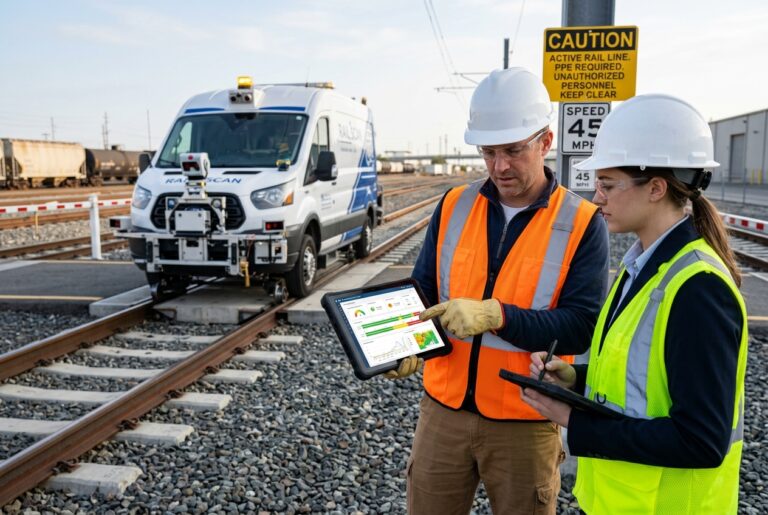
AI-based incident prediction models are moving from research pilots into operational safety programs across railroad, logistics, transportation, and warehouse operations, and federal safety agencies are building oversight frameworks for the technology at nearly the same pace companies are adopting it. Rather than waiting for an incident to happen and then investigating it, these systems analyze sensor data, inspection imagery, and historical crash or defect records to flag risk before a failure occurs. That shift, from reactive investigation to predictive risk scoring, is genuinely valuable for safety outcomes, but it also introduces a governance question most existing safety programs were not built to answer: how does a company validate, document, and take responsibility for a safety decision that an algorithm helped make.
Industry Impact: Where AI Incident Prediction Is Already Deployed
The exposure and the opportunity look different across railroad, transportation, and logistics operations, but each sector is already running real AI-based prediction programs, not just evaluating the concept. On the railroad side, researchers at the University of Illinois at Urbana-Champaign published a Phase 2 report for the Federal Railroad Administration in 2026 detailing a system that pairs LRAIL 3D laser triangulation scanning with deep convolutional neural networks to assess track condition. The research introduces two quantified risk metrics, a Track Component Health Index that evaluates ballast, crossties, and fastener condition, and a Track Strength Index that specifically measures track buckling resistance to predict derailment risk, giving infrastructure managers an objective, data-driven basis for prioritizing maintenance rather than relying solely on reactive inspection schedules (de Oliveira Lima et al., 2026). For a railroad, that means derailment risk is increasingly being expressed as a quantified index score before a failure occurs, not discovered after one.
In trucking and other commercial motor vehicle operations, the Federal Motor Carrier Safety Administration commissioned Virginia Tech Transportation Institute researchers to evaluate artificial intelligence and decision support systems specifically for Crash Preventability determinations, the program that reviews whether a crash was reasonably preventable by the motor carrier. With the program having received over 12,000 Requests for Data Review since its inception, and roughly 94 percent of reviewed crashes ultimately determined not preventable, the resulting 2024 study evaluated the economic, technical, and operational feasibility of applying AI tools to streamline how Police Accident Reports are processed and validated against crash data (Miller et al., 2024). That is a narrower application than full crash prediction, but it establishes a federal research precedent for how AI-assisted determinations in safety-critical review processes will be evaluated and documented going forward.
Logistics and warehouse operations face a broader and less sector-specific version of this same trend. Rather than a single predictive model tied to one type of equipment or inspection, warehouses are increasingly layering AI-based monitoring across near-miss detection, ergonomic risk scoring, and predictive maintenance for material handling equipment. The National Institute for Occupational Safety and Health addressed this directly in a January 2026 Science Bulletin, noting that artificial intelligence hazards in the workplace can largely be evaluated using established occupational health frameworks rather than requiring an entirely new regulatory category, while still requiring employers to distinguish between hazards created by how a system is designed and hazards created by how it is deployed and managed on the floor (Sadowski & Howard, 2026).
Regulatory Implications: Oversight Frameworks Are Being Built Around Deployed Technology
Three developments define how AI-based incident prediction is being governed in 2026. First, the January 2026 NIOSH bulletin lays out five specific risk management strategies employers and safety professionals should apply to workplace AI systems: reskilling safety professionals in the technical fundamentals needed to evaluate algorithmic tools, running collaborative evaluations between AI developers and occupational health practitioners, commissioning independent audits using algorithmic transparency tools, supporting AI system certification programs that incentivize trustworthy design, and applying safety case methodologies to formally document how high-risk AI systems were evaluated before deployment (Sadowski & Howard, 2026). That framework draws an explicit line between “prevention through work design,” which is the employer’s responsibility, and “prevention through software design,” which sits with the developer, a distinction that matters directly for any company purchasing a third-party AI prediction tool rather than building one internally.
Second, the FRA-funded Phase 2 track inspection research out of the University of Illinois signals that federal rail safety research is actively validating specific AI methodologies, not just studying the concept abstractly. A Track Strength Index built to predict buckling-related derailment risk is a metric railroads can expect to see referenced in future FRA guidance or inspection program discussions, which means railroads piloting their own AI-based track assessment tools should be tracking how closely their internal metrics align with the framework this federally funded research is establishing (de Oliveira Lima et al., 2026).
Third, the Virginia Tech Transportation Institute’s research for FMCSA establishes that federal transportation safety agencies expect any AI tool used in a safety-critical determination to be evaluated for economic, technical, and operational feasibility before broader deployment, the same three-part evaluation framework applied throughout that 2024 study (Miller et al., 2024). No federal agency covered here has issued a dedicated AI safety standard specific to railroad, transportation, or warehouse operations. In the absence of one, the general duty obligation to furnish a workplace free from recognized hazards continues to apply to AI-based systems the same way it applies to any other equipment or process a company introduces (Occupational Safety and Health Act [OSH Act], 1970, § 5(a)(1)).
Business Implications: Accuracy, Liability, and the Human Oversight Question
The financial and liability exposure from AI-based incident prediction runs in a different direction than most traditional safety technology, because the risk is not primarily that the equipment fails, it is that the model’s output is wrong, unexplainable, or acted on without adequate human review. A railroad that lowers its inspection frequency on a segment because an AI-generated Track Strength Index scored it as low-risk, and that segment subsequently fails, faces a very different liability conversation than a railroad that missed a defect during a conventional visual inspection: the question becomes not just what happened, but what the model said, what data it was trained on, and who reviewed and accepted its output before the inspection interval was changed. A trucking company relying on an AI decision support tool to help determine crash preventability needs a documented process showing a qualified human reviewed and validated that determination, not simply that the software produced one. A warehouse that deploys an AI-based near-miss or ergonomic risk monitoring system without the kind of collaborative evaluation and documentation the NIOSH framework recommends is building a program that will be difficult to defend if an injury occurs in an area the system rated as low-risk.
Beyond direct liability, insurers and regulators are beginning to ask the same underlying question companies need to be prepared to answer for themselves: was this AI system evaluated before deployment, is its output reviewed by a qualified person before it drives an operational decision, and is that review documented. Companies that can answer all three questions with actual records are in a materially stronger position, both for regulatory inspection and for insurance underwriting, than companies that adopted a predictive tool because a vendor demonstrated impressive accuracy in a sales presentation.
Risk Reduction Strategies: Applying the Four Pillars to Predictive AI Adoption
Safety and health training for AI-based incident prediction has to extend to the people interpreting the model’s output, not just the people operating the equipment the model monitors. Track inspectors need to understand what a Track Strength Index score actually represents and its known limitations, not treat it as an infallible replacement for physical inspection judgment. Safety personnel reviewing AI-flagged crash preventability determinations need enough technical literacy to recognize when a model’s output does not match the underlying facts of an incident, which is precisely the reskilling the NIOSH framework calls for.
Hazard prevention and control for predictive AI systems means building in human review checkpoints before a model’s output changes an operational decision, whether that decision is an inspection interval, a driver coaching action, or a warehouse workflow change. Worksite analysis means the collaborative evaluations and independent audits the NIOSH bulletin recommends, conducted before a system is deployed at scale and revisited as the system continues to learn from new data, since a model’s accuracy and blind spots can shift as its training data grows. Management commitment and employee involvement is what ties an AI governance program together: a documented structure assigning clear ownership for validating, auditing, and overriding AI-based predictions, rather than treating the technology as a black box that safety staff are simply expected to trust.
The Key Safety LLC Approach
Key Safety LLC helps railroad, transportation, logistics, and warehouse companies build the governance documentation that AI-based incident prediction tools require but rarely ship with. For companies piloting or scaling a predictive AI system, our Document Development for Start-Up Projects service builds the evaluation records, human-review protocols, and safety case documentation a new AI-assisted program needs before an incident forces the question of how it was validated. For companies facing an active question about how to document an AI-assisted safety decision after the fact, our Service on Demand model provides direct access to EHS expertise without a long-term retainer. For companies that want an ongoing partner tracking how FRA-funded research, FMCSA-commissioned studies, and NIOSH guidance on AI safety systems continue to develop, our Regular Consultation Services keep your governance program current as this technology and its oversight framework both continue to mature.
Conclusion
AI-based incident prediction models are already operating inside railroad, transportation, logistics, and warehouse safety programs, and the federal research validating specific methodologies, from the University of Illinois’s Track Strength Index work for FRA to Virginia Tech Transportation Institute’s crash preventability decision support study for FMCSA to NIOSH’s workplace AI hazard framework, is being published in real time alongside that adoption. Companies that treat these systems as validated, documented, and human-reviewed tools, rather than as an unquestioned black box, will be the ones able to defend their safety decisions when a regulator, an insurer, or a plaintiff’s attorney eventually asks how the model’s output was checked before anyone acted on it.
Contact Key Safety LLC to review your AI-based incident prediction governance program: https://key-safety.com/contact-us/
References
de Oliveira Lima, A., Edwards, J. R., Barbosa, I. G., Zadeh Arjomandi, S. S., Palma, P., & Dersch, M. S. (2026). Laser triangulation and deep neural networks for rail safety inspections – Phase 2: Framework for isolating and reporting track changes (Report No. DOT/FRA/ORD-26/03). University of Illinois at Urbana-Champaign; U.S. Department of Transportation, Federal Railroad Administration. National Transportation Library, ROSA P. https://rosap.ntl.bts.gov/view/dot/89889
Miller, A., Datta, D., Sundharam, V., Sarkar, A., Rooney, G., & Lobb, C. (2024). AI and decision support systems for crash preventability PAR processing (Report No. FMCSA-RRT-22-009). Virginia Tech Transportation Institute; Federal Motor Carrier Safety Administration, Office of Research. National Transportation Library, ROSA P. https://rosap.ntl.bts.gov/view/dot/78877
Occupational Safety and Health Administration. (1970). OSH Act of 1970: Section 5, Duties (29 U.S.C. § 654). U.S. Department of Labor. https://www.osha.gov/laws-regs/oshact/section5-duties
Sadowski, J. P., & Howard, J. (2026, January 18). Practical strategies to manage AI hazards in the workplace. NIOSH Science Bulletin. Centers for Disease Control and Prevention. https://www.cdc.gov/niosh/bulletin/2026/practical-strategies-to-manage-ai-hazards-in-the-workplace.html
