

Autonomous Systems and Safety Governance: What Transportation, Logistics, and Railroad Leaders Need to Know
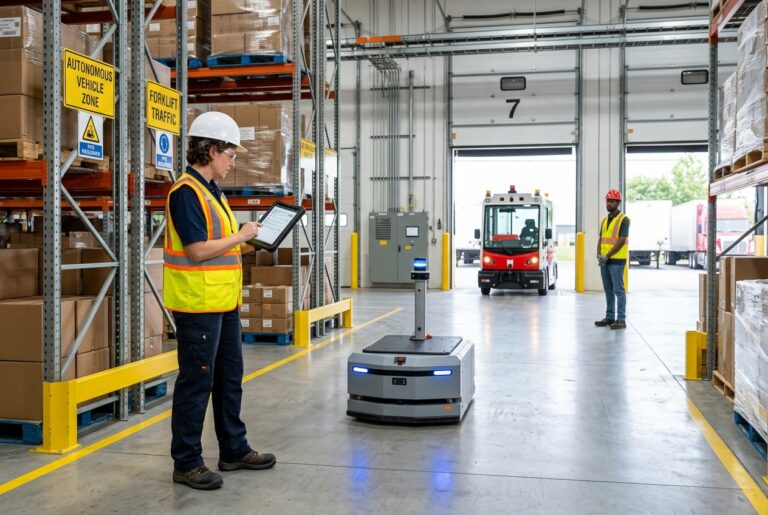
Autonomous systems are no longer a pilot-program curiosity for transportation, logistics, and railroad operators, they are becoming embedded operational infrastructure, and the safety governance framework meant to oversee them is being rewritten in real time. Self-driving trucks are moving from closed test tracks toward commercial freight lanes. Autonomous mobile robots are becoming standard equipment on warehouse and distribution-center floors. And railroads are pushing for reduced crew sizes as a step toward greater automation, even as federal regulators and the courts push back. For companies operating in these sectors, 2026 is the year the regulatory ground underneath autonomous systems shifted substantially, and safety governance built around last year’s rules is already out of date.
Industry Impact: Where Autonomous System Risk Concentrates
The exposure looks different across transportation, logistics, and railroad operations, but each sector is confronting the same underlying challenge: existing safety frameworks were built around a human operator, and autonomous systems break that assumption in ways regulators are still working through. For trucking and other commercial motor vehicle operations, the U.S. Department of Transportation released its National Strategy for Automated Vehicles in September 2026, laying out a Fiscal Year 2026–2030 roadmap built around four objectives: prioritizing safety oversight as the automated driving system industry expands, modernizing regulations written around human-driver assumptions, promoting domestic and international commercial deployment, and building interoperable data corridors across state lines (U.S. Department of Transportation, 2026). Within that strategy, the Federal Motor Carrier Safety Administration is developing operational safety regulations specifically for automated driving system-equipped commercial motor vehicles, covering everything from inspection and maintenance requirements to emergency response protocols that guide first responders on how to safely interact with a truck that has no human driver behind the wheel (U.S. Department of Transportation, 2026).
Logistics operations face a quieter but equally consequential version of this same gap on the warehouse floor. Industrial mobile robots, autonomous forklifts, and collaborative picking robots are now common fixtures in distribution centers, but the Occupational Safety and Health Administration has been explicit that no dedicated federal standard governs robotics as an industry (Occupational Safety and Health Administration, n.d.). Instead, existing general industry standards apply by extension: machine guarding requirements, lockout/tagout procedures for hazardous energy control, and walking-working surface rules, none of which were written with a robot that navigates autonomously around a moving workforce in mind. OSHA’s own technical guidance acknowledges this gap directly, describing industrial mobile robots as systems that “can navigate autonomously within their operating environment to reach specified locations” and recommending that employers build safety programs around comprehensive, task-based risk assessments rather than waiting for a dedicated robotics standard that does not yet exist (Occupational Safety and Health Administration, n.d.).
Railroads sit at the most contested point of this transition. The Federal Railroad Administration finalized minimum train crew staffing requirements in April 2024, generally mandating at least two crew members on freight operations with narrow exceptions for specific legacy, passenger, and work-train operations (Federal Railroad Administration, 2024). The rule was a direct response to industry interest in reduced-crew and eventually crewless freight operations enabled by increasing automation. Class I railroads and their trade associations challenged the rule, and in August 2026 the U.S. Court of Appeals for the Eleventh Circuit rejected that challenge in full, upholding the two-person crew requirement against arguments that the rule was arbitrary and capricious (Association of American Railroads v. Federal Railroad Administration, 2026). For railroads that had built automation roadmaps around an eventual reduction in crew size, that ruling is a direct regulatory constraint on how far autonomous rail operations can advance in the near term, regardless of the technology’s technical readiness.
Regulatory Implications: A Framework Under Active Revision
Three regulatory developments in 2026 matter most for companies managing autonomous systems and safety governance across these sectors. First, the National Highway Traffic Safety Administration withdrew its proposed Automated Driving System-Equipped Vehicle Safety, Transparency, and Evaluation Program, known as AV STEP, in June 2026, after determining that the voluntary reporting structure would create compliance burdens that outweighed its benefits and that separate initiatives announced in 2025 better served the program’s original safety-transparency goals (National Highway Traffic Safety Administration, 2026). Companies that had begun preparing for AV STEP’s disclosure and evaluation requirements now need to redirect that compliance effort toward the streamlined exemption processes and crash-reporting requirements NHTSA is pursuing instead.
Second, and published the same day as the AV STEP withdrawal, NHTSA proposed substantial updates to Federal Motor Vehicle Safety Standard No. 135, the brake system standard that has governed light vehicles since 1995. The proposal would allow fully autonomous vehicles to omit traditional foot pedals and hand controls entirely, require that braking be controlled by onboard systems rather than external commands, and redefine how stopping distance is measured for automated driving system-equipped vehicles, shifting the measurement point from physical pedal force to the moment an electronic braking command is transmitted (National Highway Traffic Safety Administration, 2026). NHTSA has been clear that the underlying safety performance standards are not being relaxed, only the design pathway used to meet them, but any manufacturer or fleet operator building toward the current brake standard needs to track this rulemaking closely before finalizing vehicle specifications.
Third, the Federal Railroad Administration’s crew-size rule survived its most significant legal test to date when the Eleventh Circuit upheld it against a coordinated challenge from the Association of American Railroads, the American Short Line and Regional Railroad Association, and six individual railroads (Association of American Railroads v. Federal Railroad Administration, 2026). With that challenge exhausted at the circuit court level, railroads pursuing automation strategies premised on reduced crew requirements now face a settled regulatory floor rather than an open legal question, at least for the foreseeable future.
Business Implications: Governance Gaps Carry Real Operational Cost
The financial and operational exposure from autonomous systems runs differently across each sector, but the common thread is that a safety governance program built for human-operated equipment does not automatically transfer to an autonomous one. A trucking company deploying automated driving system-equipped commercial motor vehicles ahead of finalized Federal Motor Carrier Safety Administration operational rules is operating in a regulatory gray zone where maintenance, inspection, and emergency response expectations are still being defined, which raises both compliance uncertainty and liability exposure in the event of an incident. A logistics operation running industrial mobile robots without a documented task-based risk assessment is relying on general machine-guarding and lockout/tagout standards that were not written for a robot capable of independently navigating around workers, a gap an OSHA inspector or, more likely, a workers’ compensation carrier or plaintiff’s attorney will identify quickly after any injury involving that equipment. A railroad that built a business case around reduced crew automation now has a definitive appellate ruling establishing that the current regulatory floor is two crew members, meaning any capital planning premised on a different staffing model needs to be revisited now rather than after further investment.
Beyond direct compliance exposure, all three sectors face a workforce and insurance dimension. Underwriters evaluating autonomous vehicle fleets, warehouse robotics programs, or rail automation initiatives increasingly ask for the same thing: a documented safety governance framework showing that the company understands where existing regulations still apply, where they do not yet exist, and how the company is managing that gap in the interim. Companies without that documentation face higher premiums, more restrictive coverage terms, or, in some cases, difficulty securing coverage at all for autonomous equipment.
Risk Reduction Strategies: Applying the Four Pillars to a Moving Regulatory Target
Safety and health training for autonomous systems has to go beyond generic equipment orientation to address the specific interaction risks each technology introduces. Personnel working near automated driving system-equipped trucks in a yard or distribution facility need training on how those vehicles signal intent and how to interact safely with a vehicle that has no human driver to make eye contact with or wave off. Warehouse personnel working alongside industrial mobile robots need training grounded in the task-based risk assessment OSHA recommends, not a one-time orientation delivered when the robots were first installed. Rail personnel need continued training on the alerter systems, communication protocols, and emergency mitigation procedures the Federal Railroad Administration’s crew rule requires for any approved one-person operations.
Hazard prevention and control looks different for each technology as well. For automated trucks, that means tracking Federal Motor Carrier Safety Administration guidance as it develops and building maintenance and inspection protocols that anticipate coming requirements rather than waiting for a final rule. For warehouse robotics, that means engineering controls such as interlocked barriers and presence-sensing devices layered with administrative controls, exactly the hierarchy OSHA’s own technical guidance recommends. For rail, that means documenting compliance with the crew-size rule’s safety measures for any one-person operations still permitted under its exceptions.
Worksite analysis for autonomous systems means revisiting risk assessments on a schedule tied to the pace of regulatory change, not a fixed annual cycle. With NHTSA actively rulemaking on brake standards, the Federal Motor Carrier Safety Administration developing new commercial motor vehicle regulations, and rail crew requirements newly affirmed by an appellate court, a risk assessment completed even six months ago may already be missing a material development. Management commitment and employee involvement ties the program together: a documented governance structure that assigns clear ownership for tracking autonomous-systems regulatory activity, rather than leaving that responsibility to whoever happens to notice a new rule in trade press.
The Key Safety LLC Approach
Key Safety LLC helps transportation, logistics, and railroad companies build safety governance programs that keep pace with a regulatory environment moving faster than most internal compliance calendars can track on their own. For companies piloting or scaling automated driving system-equipped vehicles or warehouse robotics, our Document Development for Start-Up Projects service builds the task-based risk assessments, training programs, and compliance documentation a new autonomous operation needs before an incident or an inspection forces the issue. For companies facing an active question about how a new NHTSA or FMCSA rule applies to their fleet, our Service on Demand model provides direct access to EHS expertise without a long-term retainer. For companies that want an ongoing partner tracking NHTSA, FMCSA, and FRA rulemaking activity on their behalf, our Regular Consultation Services keep your safety governance program current as this regulatory landscape continues to evolve.
Conclusion
Autonomous systems and safety governance will remain a moving target for transportation, logistics, and railroad companies through the remainder of this decade, as the Department of Transportation’s new national strategy, NHTSA’s active rulemaking on both vehicle equipment and voluntary reporting programs, and the Federal Railroad Administration’s newly affirmed crew requirements all continue to reshape what compliance looks like in practice. Companies that build governance programs designed to track and adapt to that pace of change, rather than programs built once and left in place, protect their people, their operations, and their ability to keep deploying autonomous technology as the rules that govern it continue to take shape.
Contact Key Safety LLC to review your autonomous systems safety governance program
References
Association of American Railroads v. Federal Railroad Administration, No. 24-11366 (11th Cir. Aug. 12, 2026). https://www.govinfo.gov/app/details/USCOURTS-ca11-24-11366
Federal Railroad Administration. (2024, April 9). Train crew size safety requirements. Federal Register. https://www.federalregister.gov/documents/2024/04/09/2024-06625/train-crew-size-safety-requirements
National Highway Traffic Safety Administration. (2026, June 26). ADS-equipped vehicle safety, transparency, and evaluation program; withdrawal. Federal Register. https://www.federalregister.gov/documents/2026/06/26/2026-12980/ads-equipped-vehicle-safety-transparency-and-evaluation-program-withdrawal
Occupational Safety and Health Administration. (n.d.). Industrial robot systems and industrial robot system safety (OSHA Technical Manual, Section IV, Chapter 4). U.S. Department of Labor. https://www.osha.gov/otm/section-4-safety-hazards/chapter-4
U.S. Department of Transportation. (2026, September 3). National strategy for automated vehicles. https://www.transportation.gov/sites/dot.gov/files/2026-09/AV%20National%20Strategy_508_3Sep2026.pdf
