

BIM and Safety Integration in Construction and Railroad Projects
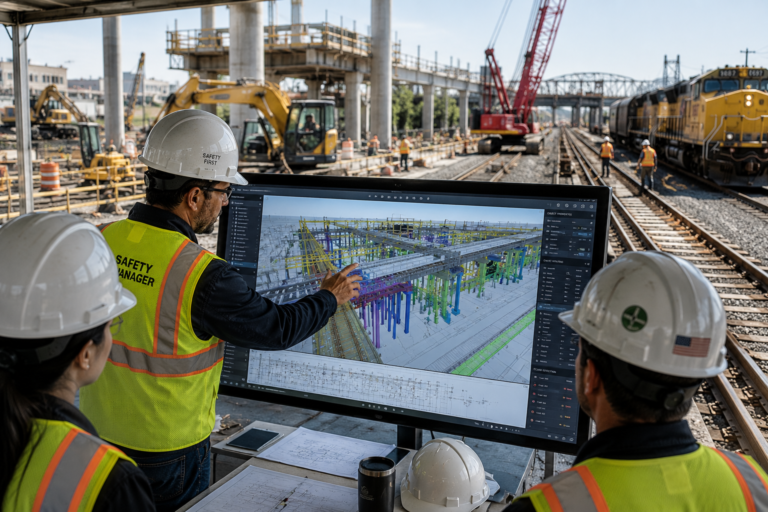
EHS consulting and OSHA compliance strategies are evolving as Building Information Modeling (BIM) becomes more integrated into construction and railroad project management. What was once viewed primarily as a design and coordination tool is increasingly being recognized as a critical component of safety management, operational planning, and risk reduction.
In construction and railroad environments, project complexity creates continuous exposure to safety risks. Multiple contractors, changing work conditions, heavy equipment operations, and dynamic schedules increase the likelihood of communication gaps and operational conflicts. BIM introduces the ability to visualize these risks before work begins, allowing organizations to identify hazards earlier and improve decision-making across project phases.
The Occupational Safety and Health Administration emphasizes the importance of hazard identification and planning in preventing workplace incidents (Occupational Safety and Health Administration [OSHA], n.d.). BIM supports this objective by enabling project teams to digitally simulate work environments, equipment movement, access routes, and sequencing before physical operations begin.
In railroad construction projects, where operations often occur near active tracks and transportation infrastructure, the ability to model operational risk is particularly valuable. BIM can assist in identifying clearance conflicts, restricted access areas, equipment interactions, and logistical challenges that may not be fully visible in traditional planning documents.
The strategic value of BIM in safety management extends beyond visualization. When integrated properly, BIM becomes a centralized platform connecting design, scheduling, field operations, and safety planning. This integration improves coordination between project stakeholders and strengthens communication regarding hazards and operational controls.
ISO 45001 emphasizes proactive hazard identification, worker participation, and continual improvement within safety management systems (International Organization for Standardization, 2018). BIM aligns closely with these principles by allowing organizations to evaluate risks earlier and make informed operational decisions before work activities begin.
One of the most significant advantages of BIM is its ability to improve pre-task planning. By integrating safety considerations directly into project models, organizations can evaluate crane positioning, material flow, equipment access, and worker movement in advance. This proactive approach reduces uncertainty and improves operational readiness.
However, technology alone does not improve safety performance. Organizations frequently implement BIM platforms without integrating them into safety workflows or field operations. In these cases, BIM remains a design tool rather than becoming part of the organization’s risk management strategy.
Leadership involvement is critical in determining whether BIM contributes to measurable safety improvements. Project leaders, safety managers, and operations teams must collaborate throughout the project lifecycle to ensure that safety considerations are embedded into planning and execution processes.
Another challenge involves data coordination and standardization. Construction and railroad projects often involve multiple contractors and engineering teams using different systems and workflows. Without clear governance, safety-related information can become fragmented, reducing the effectiveness of BIM as a risk management tool.
Workforce engagement also remains essential. Field personnel must understand how BIM-generated information applies to operational conditions. When workers view BIM as disconnected from field realities, adoption declines and safety opportunities are lost.
Organizations successfully integrating BIM into safety management are approaching it as more than a visualization platform. They are using it to improve communication, support operational planning, and strengthen hazard identification throughout the project lifecycle.
EHS consulting partners often support this process by aligning BIM workflows with OSHA compliance requirements, operational risk assessments, and ISO-based safety management systems. This approach helps organizations move beyond technology adoption and toward measurable operational improvement.
As construction and railroad projects continue increasing in complexity, organizations are under greater pressure to improve coordination, reduce exposure, and strengthen safety performance. BIM provides a significant opportunity to support these objectives when integrated strategically into project planning and operational decision-making.
The future of safety management in complex infrastructure projects will depend not only on technology adoption, but on how effectively organizations integrate those tools into real-world operational controls and leadership practices.
References
International Organization for Standardization. (2018). Occupational health and safety management systems – Requirements with guidance for use. (ISO Standard No. 45001:2018) https://www.iso.org/standard/63787.html
Occupational Safety and Health Administration. (n.d.). Recommended practices for safety and health programs. U.S. Department of Labor. https://www.osha.gov/safety-management
Comments:
