

Hydrogen and Ammonia Safety Challenges: What Environmental, Transportation, and Oil & Gas Leaders Need to Know
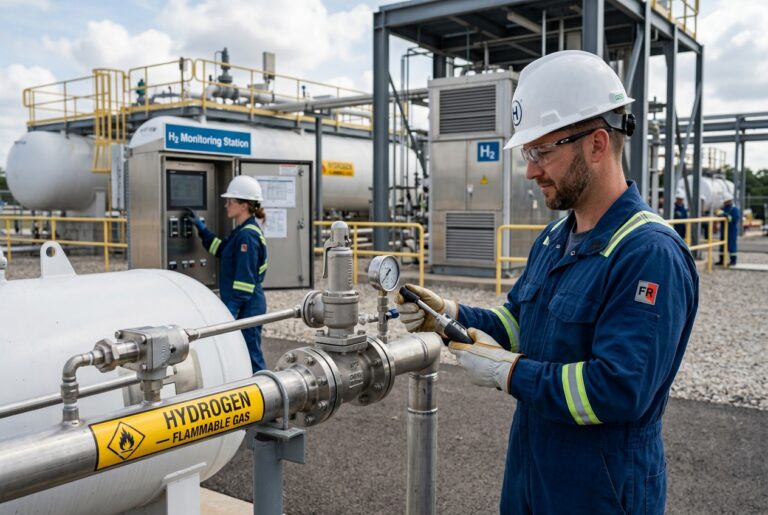
Hydrogen and ammonia safety challenges are moving from a narrow, specialized concern into mainstream operational risk. Both substances are decades-old industrial chemicals with well-documented hazards, but both are now being produced, stored, and transported at a scale the existing safety infrastructure was never built around. Hydrogen is being positioned as a clean fuel and industrial feedstock; ammonia is being positioned as a hydrogen carrier, a marine fuel, and an export commodity, on top of its long-standing role in fertilizer production and industrial refrigeration. For environmental, transportation, and oil & gas companies, that growth means hydrogen and ammonia safety challenges are no longer confined to a handful of specialized chemical plants and agricultural retailers. They are becoming a shared operational reality across new fueling infrastructure, expanding pipeline networks, and the rail and highway corridors that move both substances in industrial quantities every day.
Industry Impact: Where Hydrogen and Ammonia Risk Concentrate
The exposure looks different across environmental, transportation, and oil & gas operations, but both chemicals share a common thread: they are unforgiving of small process or storage failures. Ammonia’s primary hazard is acute inhalation toxicity. The National Institute for Occupational Safety and Health sets ammonia’s Immediately Dangerous to Life or Health concentration at 300 ppm, well below the concentration a release can reach within seconds near a leaking valve or ruptured line, and OSHA’s permissible exposure limit sits at just 50 ppm as an eight-hour time-weighted average (National Institute for Occupational Safety and Health [NIOSH], 1994). Environmental compliance teams managing anhydrous ammonia at refrigeration facilities, fertilizer terminals, or wastewater treatment plants are managing a toxic release hazard first and a regulatory paperwork exercise second.
Hydrogen’s hazard profile is almost the opposite. It carries no meaningful acute toxicity, but it is flammable across an extraordinarily wide concentration range in air, ignites with very little energy, and burns with a flame that is nearly invisible in daylight. OSHA’s hydrogen storage standard requires ASME-code containers, mandatory safety relief devices, permanent “Hydrogen — Flammable Gas — No Smoking — No Open Flames” placarding, and minimum separation distances that scale with system size, from outdoor-preferred siting for smaller gaseous systems up to outdoor-only requirements above 15,000 cubic feet, with liquefied hydrogen above 600 gallons facing the same outdoor-only threshold (Occupational Safety and Health Administration [OSHA], 2007). For oil & gas companies building hydrogen production, blending, or fueling infrastructure, that standard was written in 2007, long before today’s scale of hydrogen fueling stations and blending projects, which means many of today’s newest hydrogen assets are the first real-world test of a decades-old rule.
Transportation companies face both hazards simultaneously and from a different angle: moving them, not storing them. Rail tank cars, highway cargo tanks, and nurse tanks carrying anhydrous ammonia are governed by a distinct set of federal specifications from those carrying flammable liquids, and hydrogen’s transport as a compressed or cryogenic liquefied gas brings its own container, labeling, and routing requirements. A pipeline or tank car failure involving either substance is rarely just an operational loss. For ammonia, it is a potential toxic release with public evacuation implications; for hydrogen, it is a potential fire or explosion event, and both draw immediate scrutiny from regulators, first responders, and the communities near the facility or route.
Regulatory Implications: A Framework Under Active Revision
Three regulatory developments matter most for companies managing hydrogen and ammonia safety challenges in 2026. First, both chemicals sit squarely inside the two regulatory programs built specifically for catastrophic chemical release prevention. OSHA’s Process Safety Management standard and the EPA’s Risk Management Program both apply once a facility holds 10,000 pounds or more of anhydrous ammonia, and the same 10,000-pound threshold applies to hydrogen under the EPA’s regulated substances list, meaning many facilities handling either chemical at meaningful scale are managing two parallel federal compliance programs, not one (List of Substances, 2024).
Second, the RMP program itself is in the middle of a significant regulatory swing. The EPA’s proposed “Common Sense Approach to Chemical Accident Prevention” rule, published in the Federal Register in February 2026, would roll back several requirements added to the RMP program in 2024, including safer-technology analysis obligations for existing petroleum and chemical manufacturing processes, third-party audit triggers, expanded employee participation and training requirements, and public access to facility-level data through the RMP Public Data Tool (Environmental Protection Agency [EPA], 2026). Facilities that built their 2024–2025 compliance roadmap around the stricter version of the rule now need to track which requirements survive the final version of this rulemaking, and which do not, rather than assuming the rule they planned around will still be the rule in force by year’s end.
Third, on the transportation side, PHMSA published a proposed rule in July 2026 overhauling how pipeline operators must respond to detected anomalies on hazardous liquid and gas transmission pipelines, replacing a patchwork of response timeframes with a smaller set of categories tied to engineering-based failure pressure ratios rather than depth measurements alone (Pipeline and Hazardous Materials Safety Administration [PHMSA], 2026). The rule does not single out hydrogen or ammonia pipelines by name, but it will directly shape how operators of any transmission pipeline, including the hydrogen and ammonia infrastructure now in development, are expected to detect, prioritize, and repair the integrity threats specific to each commodity.
Business Implications: Two Chemicals, Two Very Different Failure Modes
The financial and operational exposure runs in different directions for each chemical, which is exactly what makes managing both under one safety program difficult. An ammonia release event triggers immediate community notification obligations, emergency response mobilization, and a public record of the incident that follows the facility indefinitely. A hydrogen event more often manifests as property damage, business interruption, and equipment loss from fire or explosion, with a lower likelihood of offsite toxic exposure but a higher likelihood of catastrophic asset loss if ignition occurs in a poorly ventilated or poorly separated storage area. Both outcomes carry the same downstream cost: a documented incident that becomes part of the company’s compliance history, visible to insurers, regulators, and, increasingly, to communities and business partners evaluating whether a facility is safe to be near or do business with.
Companies operating under both OSHA’s PSM standard and the EPA’s RMP simultaneously also carry a compounding administrative burden that pure penalty figures understate. Process hazard analyses, mechanical integrity programs, operating procedures, and emergency response plans typically have to satisfy both regulators’ documentation expectations, and a gap identified by one agency’s inspector is very likely to be relevant to the other agency’s inspection as well.
Risk Reduction Strategies: Applying the Four Pillars to Two Distinct Hazards
Safety and health training for hydrogen and ammonia has to be substance-specific, not generic hazardous chemical training. Personnel working around ammonia need to recognize the smell threshold, know evacuation and self-contained breathing apparatus procedures, and understand that ammonia is lighter than air in its vapor form under most release conditions, which affects where it travels. Personnel working around hydrogen need training on its wide flammability range, the near-invisibility of a hydrogen flame in daylight, and the importance of never assuming an area is safe simply because no smoke or visible fire is present. Hazard prevention and control looks equally different for each: ammonia systems depend on leak detection, secondary containment, and scrubber or water-curtain mitigation systems, while hydrogen systems depend on ventilation, spark-free equipment, bonding and grounding, and the specific separation distances OSHA’s hydrogen standard sets by container size and construction type.
Worksite analysis for both chemicals means process hazard analyses and mechanical integrity inspections that are current, not filed away from a facility’s original startup years earlier. Management commitment and employee involvement is what ties a dual-hazard program together: a documented management structure that treats ammonia’s toxic release risk and hydrogen’s fire and explosion risk as two distinct technical disciplines under one unified safety leadership, rather than folding both into a single generic “hazardous chemical” checklist that fits neither hazard well.
The Key Safety LLC Approach
Key Safety LLC helps environmental, transportation, and oil & gas companies build process safety and risk management programs that treat hydrogen’s flammability hazards and ammonia’s toxicity hazards as the distinct technical disciplines they are, rather than forcing both into a one-size-fits-all chemical safety template. For companies bringing new hydrogen or ammonia handling capacity online, our Document Development for Start-Up Projects service builds the process hazard analyses, OSHA PSM and EPA RMP program elements, and transportation compliance documentation a new operation needs before its first regulatory inspection. For companies facing an active compliance question or an unexpected finding, our Service on Demand model provides direct access to EHS expertise without a long-term retainer. For companies that want an ongoing partner tracking both the EPA’s evolving RMP rule and PHMSA’s transportation rulemakings on their behalf, our Regular Consultation Services keep your program current as the regulatory landscape continues to shift.
Conclusion
Hydrogen and ammonia safety challenges will only grow more central to environmental, transportation, and oil & gas operations as both chemicals scale into new infrastructure and new transport volumes. Companies that build dedicated, substance-specific safety programs for each hazard, rather than treating both as interchangeable “hazardous chemicals,” protect their people, their communities, and their ability to keep operating through a regulatory environment that is still actively being rewritten in 2026.
Contact Key Safety LLC to review your hydrogen and ammonia safety program before your next inspection: https://key-safety.com/contact-us/
References
National Institute for Occupational Safety and Health. (1994). Ammonia: Immediately dangerous to life or health concentrations (IDLH) (CAS No. 7664-41-7). Centers for Disease Control and Prevention. https://www.cdc.gov/niosh/idlh/7664417.html
Occupational Safety and Health Administration. (2026). Hydrogen (29 C.F.R. § 1910.103). U.S. Department of Labor. https://www.osha.gov/laws-regs/regulations/standardnumber/1910/1910.103
Environmental Protection Agency. (2024). List of substances (40 C.F.R. § 68.130). Electronic Code of Federal Regulations. https://www.ecfr.gov/current/title-40/chapter-I/subchapter-C/part-68/subpart-F/section-68.130
Process Safety Management of Highly Hazardous Chemicals, 29 C.F.R. § 1910.119 (2013). https://www.osha.gov/laws-regs/regulations/standardnumber/1910/1910.119
Environmental Protection Agency. (2026, February 24). Accidental release prevention requirements: Risk management programs under the Clean Air Act (Rule No. 2026-03633; 91 FR Notice). Federal Register. https://www.federalregister.gov/documents/2026/02/24/2026-03633/accidental-release-prevention-requirements-risk-management-programs-under-the-clean-air-act-common
Pipeline and Hazardous Materials Safety Administration. (2026, July 8). Pipeline safety: Repair criteria for hazardous liquid and gas transmission pipelines (Rule No. 2026-13805; 91 FR Notice). Federal Register. https://www.federalregister.gov/documents/2026/07/08/2026-13805/pipeline-safety-repair-criteria-for-hazardous-liquid-and-gas-transmission-pipelines
