

Predictive Maintenance vs. Traditional Inspections in Railroad and Manufacturing Operations
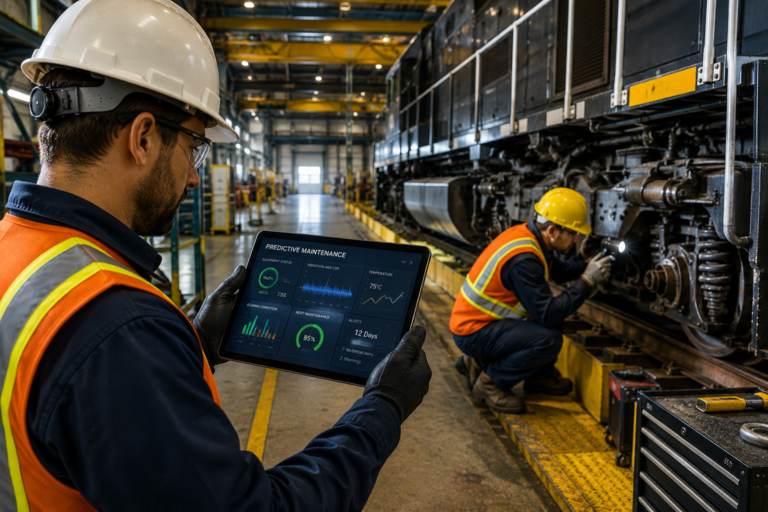
EHS consulting and OSHA compliance strategies are increasingly being influenced by predictive maintenance technologies across railroad and manufacturing operations. As organizations pursue stronger safety management systems and operational reliability, leadership teams are reevaluating the effectiveness of traditional inspection methods compared to data-driven predictive approaches.
For decades, traditional inspections have formed the backbone of maintenance and compliance programs. Scheduled inspections, manual equipment checks, and routine preventive maintenance activities remain essential in identifying visible hazards and ensuring regulatory compliance. However, the growing complexity of industrial operations is exposing the limitations of reactive and interval-based inspection models.
In railroad and manufacturing environments, operational failures often occur between scheduled inspections. Equipment degradation, vibration abnormalities, thermal changes, and structural fatigue may develop gradually without immediate visual indicators. Predictive maintenance technologies attempt to address this gap by using real-time data, sensors, and analytics to identify conditions before failures occur.
The Occupational Safety and Health Administration continues to emphasize the importance of maintaining equipment in safe operating condition as part of hazard prevention and control strategies (Occupational Safety and Health Administration [OSHA], n.d.). Predictive maintenance aligns with this objective by improving visibility into operational risk conditions that traditional inspections may not detect early enough.
In railroad operations, predictive maintenance is increasingly used to monitor track conditions, wheel integrity, braking systems, and locomotive performance. Sensors and monitoring systems provide continuous data streams that can identify anomalies before they escalate into operational failures or safety incidents. Similarly, manufacturing organizations are using predictive technologies to monitor motors, conveyors, rotating equipment, and production systems.
The strategic advantage of predictive maintenance is not simply automation it is the ability to improve decision-making through earlier risk identification. Organizations can prioritize maintenance activities based on actual equipment condition rather than fixed schedules alone. This reduces unplanned downtime while improving operational continuity and worker safety.
However, predictive maintenance does not eliminate the need for traditional inspections. One of the most common misconceptions is that technology can fully replace human observation and operational judgment. In reality, the most effective programs combine predictive analytics with physical inspections, operational expertise, and field verification.
ISO 55000 asset management principles emphasize balancing performance, risk, and cost in asset-intensive operations (International Organization for Standardization [ISO], 2024). Predictive maintenance supports this framework by helping organizations make more informed maintenance decisions while reducing operational uncertainty.
Implementation challenges remain significant. Data quality is one of the largest obstacles. Organizations often deploy monitoring systems without clear processes for interpreting alerts, escalating findings, or integrating data into maintenance workflows. Without operational discipline, predictive systems can generate excessive false positives or create information overload.
Another critical factor is workforce competency. Maintenance personnel and operational leaders must understand how predictive systems function and how to translate data into practical maintenance actions. Technology adoption without workforce alignment often leads to underutilized systems and inconsistent results.
In railroad and manufacturing environments, predictive maintenance also introduces cybersecurity and system reliability considerations. Connected monitoring systems increase dependence on digital infrastructure, requiring organizations to address data security, system redundancy, and operational continuity planning.
Leadership alignment plays a decisive role in determining success. Organizations that achieve measurable value from predictive maintenance typically integrate it into broader risk management and reliability strategies. They establish clear governance, align technology with operational priorities, and continuously evaluate system effectiveness.
Traditional inspections remain critical because they provide contextual understanding that technology alone cannot fully capture. Human interaction with equipment, environmental conditions, and operational behaviors often reveal risks that sensors may not identify. The future of effective maintenance programs is not predictive maintenance versus inspections it is the strategic integration of both.
EHS consulting partners frequently support organizations by aligning predictive maintenance initiatives with OSHA compliance requirements, operational risk assessments, and reliability strategies. This integrated approach helps organizations strengthen safety performance while improving operational efficiency.
As railroad and manufacturing operations continue evolving, organizations are under increasing pressure to improve reliability, reduce downtime, and strengthen safety management. Predictive maintenance offers significant potential, but only when implemented with operational discipline and integrated into existing maintenance and compliance frameworks.
The organizations that will lead in this transition are not abandoning traditional inspections. They are enhancing them through data-driven visibility, stronger decision-making, and integrated risk management practices.
References
International Organization for Standardization. (2024). ISO 55000 Asset management — Vocabulary, overview and principles. https://www.iso.org/standard/83053.html
Occupational Safety and Health Administration. (n.d.). Hazard prevention and control. U.S. Department of Labor. https://www.osha.gov/safety-management/hazard-prevention
Comments:
