

Safety Leadership in Highly Automated Operations: Why Human Judgment Still Decides the Outcome
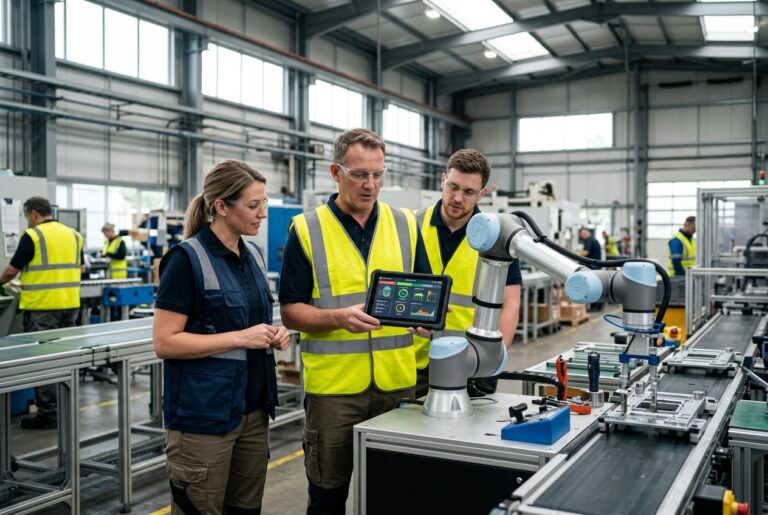
Safety leadership in highly automated operations has become the defining variable separating companies that absorb automation safely from those that discover its blind spots the hard way. Across manufacturing floors, rail corridors, and energy control rooms, machines now sense, inspect, and decide faster than any human crew could. Yet every federal agency that governs these environments, from the Occupational Safety and Health Administration to the Federal Railroad Administration, keeps arriving at the same conclusion: automation changes how hazards appear, not who is accountable for controlling them. For manufacturing, transportation, and energy organizations investing in robotics, autonomous inspection, and supervisory control systems, the technology is rarely the limiting factor. Leadership commitment, worker involvement, and governance discipline are.
Industry Impact: Automation Is Reshaping Risk, Not Eliminating It
In manufacturing, collaborative robots, mobile robots, and automated material-handling systems have moved from pilot projects to standard operating equipment. NIOSH’s own research team at the Center for Occupational Robotics Research has documented how these systems simultaneously reduce exposure to repetitive and labor-intensive tasks while introducing new energy-transfer hazards between machines and workers, particularly during programming, maintenance, and unplanned human-robot proximity events (Breloff et al., 2024). Their modeling of struck-and-pushed and struck-and-bent impact scenarios underscores a point every manufacturing safety leader needs to internalize: the moments of highest risk are not when automated systems run as designed, but when humans and machines interact outside the planned workflow.
Transportation presents a parallel story on rail. The Federal Railroad Administration’s Automated Track Inspection Program now operates across fully staffed, partially staffed, and autonomous survey modes, using automated technology to detect track defects that once depended entirely on visual human inspection (Federal Railroad Administration, 2026). Critically, FRA’s own compliance guidance states plainly that safe ATIP surveys remain “the responsibility of everyone onboard,” and that assigned FRA personnel retain authority, enforcement, and control over the policy even as the technology itself becomes more autonomous. Automation did not remove the human accountability layer; it relocated it to supervision, escalation, and exception handling.
Energy operations show the same pattern in control rooms rather than on track or shop floors. Pipeline operators running SCADA-based automated monitoring have been required for more than a decade to formalize controller roles, fatigue management, alarm prioritization, and shift-change communication specifically because human factors, not equipment failure alone, drove major incidents that regulators investigated (Pipeline and Hazardous Materials Safety Administration, 2009). As energy companies layer increasingly sophisticated automated monitoring and predictive analytics onto legacy control infrastructure, that original human-factors logic only grows more relevant, not less.
Underneath all three sectors sits a sobering baseline. The U.S. Bureau of Labor Statistics reported 213 fatalities in 2024 from workers struck, caught, or compressed by running powered equipment, a category that includes both conventional machinery and automated systems operating without adequate isolation or oversight controls (U.S. Bureau of Labor Statistics, 2026). Automation has not yet erased this hazard category; in many operations it has simply changed its shape.
Regulatory Implications: Leadership Is a Named Compliance Element, Not a Slogan
Federal safety agencies have stopped treating leadership and worker participation as cultural nice-to-haves and started codifying them as program elements. OSHA’s Recommended Practices for Safety and Health Programs identify Management Leadership and Worker Participation among the core elements every effective safety and health program must demonstrate, placing them on equal footing with hazard identification and hazard control (Occupational Safety and Health Administration, n.d.). For an operation introducing automated equipment, this means documented leadership commitment and a functioning mechanism for workers to flag automation-related concerns are not optional add-ons to a safety program; they are structural requirements regulators expect to see demonstrated, not merely stated in a policy binder.
NIOSH’s engagement with private-sector standards development reinforces the same expectation from the technical side. The institute’s 2026 update on its contributions to standards activity details active participation in industrial mobile robot standards (ANSI/RIA R15.08-1 and ANSI/A3 R15.08-2) and collaborative robot standards (ANSI/RIA 15.06), alongside methodology development aimed specifically at reducing risk during human-robot collaboration (Harris et al., 2026). These consensus standards increasingly function as the technical backbone that OSHA’s general duty clause and machine-guarding provisions reference when automated equipment is involved, meaning a manufacturing safety leader who ignores ANSI/RIA developments is, in practice, falling behind the compliance curve even without a single new OSHA rule being issued.
On the transportation side, FRA’s structuring of ATIP into graduated autonomy levels, fully staffed, partially staffed, and autonomous, creates a direct regulatory expectation that safety leadership scales its oversight intensity to match the automation level in use, rather than applying a single static inspection protocol regardless of how much human presence is actually onboard (Federal Railroad Administration, 2026). And in energy, PHMSA’s control room management framework still requires written procedures defining controller roles, training requirements, and incident review processes specifically oriented around human factors in automated monitoring environments (Pipeline and Hazardous Materials Safety Administration, 2009). Across all three regulators, the pattern holds: automation adoption does not relax documentation and governance obligations, it raises them.
Business Implications: Weak Leadership Governance Is the Expensive Failure Mode
When automation-related incidents occur, investigations rarely point to a single defective sensor or a software bug in isolation. They more often reveal a governance gap: no clear owner for automation-related hazard reviews, no defined escalation path when an automated system behaves unexpectedly, or a workforce that was never meaningfully consulted before new equipment arrived on the floor, the track, or the control room. Each of those gaps traces directly back to the leadership and worker-participation elements OSHA names explicitly in its recommended practices framework.
The business cost of that gap compounds quickly. Regulatory citations tied to inadequate safety programs carry direct penalties, but the larger exposure is operational: unplanned downtime after an automation-related incident, elevated workers’ compensation experience modifiers, reputational damage with clients who audit vendor safety performance before awarding contracts, and the difficulty of recruiting skilled technicians into facilities perceived as poorly governed around new technology. Conversely, organizations that formalize safety leadership around automation, with clear accountability, documented worker input channels, and change-management protocols for new equipment, tend to deploy automation faster and with less internal resistance, because the workforce trusts that new technology arrives with a plan rather than arriving as a surprise.
Risk Reduction Strategies: Building Leadership Structure Around Automated Systems
Effective risk reduction in highly automated operations starts with treating the Four Safety Pillars as an integrated system rather than four separate checkboxes. Safety and Health Training must be updated specifically for automation scenarios, covering not just how to operate new equipment but how to recognize when an automated system is behaving outside expected parameters and who to notify immediately. Hazard Prevention and Control needs explicit protocols for the transition moments NIOSH’s robotics research flags as highest risk: programming, maintenance, troubleshooting, and any period when guarding or isolation measures are temporarily suspended (Breloff et al., 2024).
Worksite Analysis should be expanded to include automation-specific hazard reviews before new equipment is commissioned, not only after an incident prompts a retroactive investigation, mirroring the graduated-oversight logic FRA applies across its staffed, partially staffed, and autonomous inspection modes (Federal Railroad Administration, 2026). And Management Commitment and Employee Involvement, the pillar regulators scrutinize most directly, requires visible leadership participation in automation rollout decisions and a functioning channel for frontline workers and controllers to report automation anomalies without fear of reprisal, consistent with both OSHA’s program elements and PHMSA’s human-factors requirements for control room personnel (Occupational Safety and Health Administration, n.d.); (Pipeline and Hazardous Materials Safety Administration, 2009).
Organizations that pair these structural elements with regular internal audits, cross-functional safety committees that include operations, engineering, and frontline staff, and documented incident-review loops that feed directly back into training updates consistently outperform peers that treat automation safety as a one-time installation checklist rather than an ongoing leadership discipline.
How Key Safety LLC Supports Safety Leadership in Automated Operations
Key Safety LLC helps manufacturing, transportation, and energy organizations build the governance structure that automation adoption demands, without slowing down the operational benefits automation is meant to deliver. Through Document Development for Start-Up Projects, our team builds automation-specific safety programs and hazard analyses before new equipment goes live, aligning documentation with OSHA, FRA, and PHMSA expectations from day one. Our Service on Demand model gives operations leaders direct access to EHS expertise when evaluating a new automated system or responding to an unexpected automation-related event, and our Regular Consultation Services keep safety leadership structures current as automation technology, and the standards governing it, continue to evolve.
Strong safety leadership is what allows automated systems to deliver their promised value safely and sustainably. If your organization is deploying robotics, automated inspection, or automated monitoring systems and wants to confirm your safety leadership structure meets current regulatory expectations, connect with Key Safety LLC today.
References
Breloff, S., Earnest, S., Trout, D., Brogan, A., Cheng, M., & Carr, J. (2024, November 12). Transforming construction: Automation and robotics for a safer future. National Institute for Occupational Safety and Health; Centers for Disease Control and Prevention. https://www.cdc.gov/niosh/bulletin/2024/construction-robotics.html
Federal Railroad Administration. (2026, March). Track and structures compliance manual, Volume I: General, Chapter 3 — Automated Track Inspection Program (ATIP). U.S. Department of Transportation. https://railroads.dot.gov/sites/fra.dot.gov/files/2026-03/Track_Structures_CM_2026_Vol_I_Ch3_ATIP.pdf
Harris, J., Knuth, R., Kiederer, M., Tyrawski, J., Martin, M., Attwood, W. R., Kilinc-Balci, S., Lee, E. G., Deering, A., Blackley, D., Current, R. S., & Tarley, J. L. (2026, March 23). Highlights from NIOSH contributions to private sector standards development and activities. National Institute for Occupational Safety and Health; Centers for Disease Control and Prevention. https://www.cdc.gov/niosh/bulletin/2026/standards.html
Occupational Safety and Health Administration. (n.d.). Recommended practices for safety and health programs (OSHA 3885). U.S. Department of Labor. https://www.osha.gov/safety-management
Pipeline and Hazardous Materials Safety Administration. (2009, December 3). Pipeline safety: Control room management/human factors (Docket No. PHMSA-2007-27954). Federal Register, 74(231). U.S. Department of Transportation. https://www.federalregister.gov/documents/2009/12/03/E9-28469/pipeline-safety-control-room-managementhuman-factors
U.S. Bureau of Labor Statistics. (2026, February 19). National census of fatal occupational injuries in 2024 (USDL-26-0230). U.S. Department of Labor. https://www.bls.gov/news.release/pdf/cfoi.pdf
